VOA标准英语2011--While Burma’s Chinese Businesses Thrive, Competition Worries Locals
搜索关注在线英语听力室公众号:tingroom,领取免费英语资料大礼包。
(单词翻译)
While Burma’s Chinese Businesses Thrive, Competition Worries Locals
Burma’s political reforms have dominated headlines in the past year, but there is also high anticipation1 about a series of economic reforms.
The measures could mean more opportunities for locals businesses and foreign ones, particularly Burma’s longtime trading partner, China. The Chinese competition worries some businessmen in Burma.
A man pounds a gold-trimmed ceremonial drum in a red wood frame at Rangoon’s Chinese-built Qing Fu Gong Temple. This year, the Buddhist2 temple marks its 150th anniversary and is by no means short of worshippers.
A steady stream of ethnic3 Chinese enter the temple, light incense4 and pray for good health and success.
A woman shakes a cylinder5 of Chinese fortune sticks in front of a red and gold altar.
The temple has long been a symbolic6 anchor of Rangoon’s Chinese community, which has engaged in centuries of commerce between the two nations.
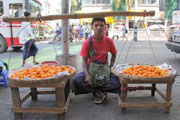 |
| Boy sells fruit on sidewalk in Rangoon, Burma, December 5, 2011 |
The temple provides Mandarin7 lessons, a free clinic and a pension for some community members, like U Htay Myint, 80. Wearing large round glasses and a baseball cap, he says there are Chinese associations in cities and towns across Burma. He says there are many Chinese businessmen in Rangoon who are running companies and factories.
Customers crowd a long glass display counter at the Golden Palace jewelry8 store. Rangoon’s Chinatown is in the heart of the city where Chinese traders have long-dominated the gold industry. And like many places around the world, Chinese-made electronics, housewares, clothes and toys fill local shops.
Burma’s government is beginning to reform its poorly managed economy by slowly reducing regulations and inefficient9 monopolies, expanding business opportunities. This month, Rangoon hosted a China Guangdong Commodities Fair with products ranging from solar panels to inflatable dolls.
Yu Fang10 Fang, sales supervisor11 for Longtron Electronics based in Guangzhou in southern China, says her company, which sells mobile phones and computers, is eager to reach Burma’s 60 million consumers. She says Burma has big potential and, although their products are sold in Africa, Europe, and South America, in Southeast Asia there are relatively12 few. She says they want to take this opportunity to get to know the market and then enter into it.
Myat Kyaw Kyaw is one of Burma’s middlemen, using his connections to help importers and exporters navigate13 bureaucracy and get licenses14. For him, the increased interest from foreign businesses can mean more opportunities. But there is still a worry that locals will not be able to compete with the new arrivals.
He says when there is an open economy inside Burma they will need a policy from the government to support local businessmen. They are weak in business experience and in competing with foreign investors15, he adds. Although he works as a broker16 Myat Kyaw Kyaw says what he really wants is to one day have a company of his own.
 收听单词发音


