VOA标准英语2011--Foragers Sample Nature's Bounty
搜索关注在线英语听力室公众号:tingroom,领取免费英语资料大礼包。
(单词翻译)
Today, most Americans get their food from the supermarket, but some are even going beyond farmers’ markets or backyard gardens for fresh produce. They're learning how to forage1 for wild edibles4.
Earth Connection, about 85 kilometers south west of Washington, DC, helps foragers learn to identify what is safe to eat and what is not.
Into the wilderness5
On a chilly6 autumn day, founder7 Tim MacWelch brushes aside some fallen leaves and exposes a small green plant with heart-shaped leaves and tiny pods.
He plucks a pod, pops it in his mouth, and gives his approval. “They’re juicy, they’re sour. They’re really good.”
The tasty plant is called wood sorrel. MacWelch doesn’t recommend plucking weeds from your yard and eating them until you’ve done some research. “There are plenty of bad plants out there that stay on my radar8.”
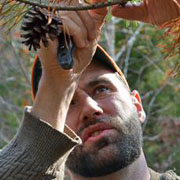 |
| According to Tim MacWelch, many parts of the pine tree are edible3, but the pine nuts, protected inside the pinecone, are too small on this particular tree to harvest. The needles, when steeped in hot water make a tea that is high in vitamin C. |
MacWelch, 40, has been a student of outdoor survival skills since he was a teenager and took up backpacking. “I thought if I could find everything I needed out in the woods, then I wouldn’t have to bring it with me.”
Becoming more self-sufficient
He founded Earth Connection in 1997 and runs workshops to share his expertise9.
MacWelch has had as many as two dozen students in classes. Today, he has two, Tamae and Bob Heilen.
Tamae says her husband has been interested in taking classes for a long time.
He says he wanted to be more self-sufficent. “I’d like to be able to know that if there were an emergency and I couldn’t get food in the store that I would be able to find food on my own.”
She got interested more recently. “I started cooking wild plants like dandelions in our yard. And it tasted really good, and I decided10, I want to study.”
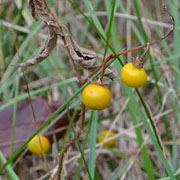 |
| The yellow fruit of the horse nettle11 looks like small tomatoes, but is highly poisonous. Even animals stay away from this plant. |
On Earth Connection’s four-hectare property, the Heilens learn about dandelions and other edible plants, like yarrow, which looks a little like a fern, but smells and tastes like a culinary herb. It also has medicinal properties, says MacWelch. “It is a styptic, which stops blood flow. It is also anti-bacterial.”
Wild carrots are also on the tasting menu for the day, but MacWelch cautions his students, they can be tricky12 to identify. Carrot roots should smell and look like smaller, white versions of the carrots found in stores.
And they should have tiny hairs on the stems. “If there are no hairs, and it smells bad," he warns, "you are looking at a poison hemlock13 or a fool’s parsley, both of which are deadly.”
Wild edibles
MacWelch offers his class on wild edibles every season, but says autumn is the best time to forage. “The salad greens that are out there are very mild and tender and sweet,” he says. “Tree nuts are abundant. There are still some berries and even some fruits in the end of the season.”
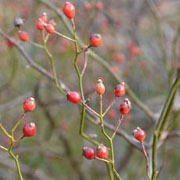 |
| Rose hips14 are sweet and high in vitamin C. |
Even with fruits and berries, he cautions, you have to be careful. “About half of the red berries are edible to a human,” he notes.
The tiny red rosehips he plucks from a bush are an excellent source of vitamin C and, as Tamae discovers, sweet. “Those are really good. I’ve seen it so many times, but I’ve never really thought that it was edible.”
MacWelch says some students take his class on wild edibles because they are searching for new flavors. “There is stuff out here that is rare, that is not easily transported, stuff that is just off the radar of normal food consumption in America.”
And stuff that may very well be growing in many Americans’ own back yards. It just requires a bit of searching. “You’re on this mission to find this thing and you’re not sure where it is,” MacWelch says, “but you know it is out there and you know it is going to be good if you get it.”
Tim MacWelch offers a variety of wilderness survival classes throughout the year at Earth Connection. He also blogs about survival skills for Outdoor Life.
 收听单词发音


