VOA标准英语2011--Asia Pacific Region Faces Rising Costs From Storms, Disasters
搜索关注在线英语听力室公众号:tingroom,领取免费英语资料大礼包。
(单词翻译)
Asia Pacific Region Faces Rising Costs From Storms, Disasters
Climate and disaster risk experts say the Asia Pacific region faces rising costs from storms and disasters often tied to climate change, creating new challenges for regions as they try to prepare and recover from such events. Warning comes as Thailand and the Philippines attempt to bounce back from recent disasters and the region gets ready to mark the seventh anniversary of the devastating1 2004 Indonesian earthquake and tsunami2.
The backhoe lifts piles of discarded rubbish left from flood-stricken homes and businesses in the Muang Ake community on the outskirts3 of Bangkok.
The community, in Pathum Thani province, was hard hit during the recent floods, with waters of up to two meters inundating4 the area for over six weeks.
On a drive through, the community is a scene of devastation5. Furniture and wall panels lay discarded, as people go about cleaning up from the most severe floods in Thailand in over 50 years.
On Saturday, Bangkok Governor Sukhumbhand Paribatra was reported to have declared that the flood waters have receded6 from the area.
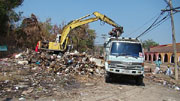 |
| A backhoe performs flood recovery work in Muang Ake, Bangkok. |
But for communities such as Muang Ake, recovery remains7 a distant goal, says Charun Likitrattanaporn, dean of agriculture at Rajamangala University of Technology campus at Muang Ake.
"This, I think, is long term because we have to reorganize. Some parts are already totally damaged. So it will take one or two years to recover. Some [businesses] cannot open again because they have to invest again in furniture, equipment. I think they cannot come back. Some of them cannot come back," said Charun Likitrattanaporn.
Nationally, almost 800 lives were lost from Thailand's floods, with an economic toll8 close to $45 billion. A state economic think tank says one million people are now unemployed9 as thousands of small businesses and several industrial estates try to revive themselves.
The United Nations says the five months of floods across Thailand, Cambodia, Laos and Vietnam affected10 a population of up to 20 million people.
This week, the Philippine regions of Cagayan de Oro and Illigan are recovering from a tropical storm that officially left 1,000 dead, but with media reports putting the toll much higher. The United Nations says more than 300,000 people were displaced and are now dependent on outside emergency assistance.
These tragedies come as Asia prepares to mark the seventh anniversary on Monday of the 2004 Indian Ocean earthquake and tsunami. The tragedy claimed over 230,000 lives across 14 countries, making it one of the deadliest natural disasters in history.
Bhichit Rattakul, from the Bangkok-based Asian Disaster Preparedness Center, says despite lessons from 2004, the region remains ill-prepared to cope with natural disasters.
"Asia prepared? The answer from my point of view is no. Even through some of the improvement has been going [on] for the last few years since the tsunami in 2004, but [there is] still a long way to go compared with the more violent situation into the future - climate change due to global warming," said Bhichit Rattakul.
The World Bank says the Asia Pacific region bears the brunt of natural disasters, accounting11 for 80 percent of lives lost globally. Economic losses from disasters are also rising exponentially as more infrastructure12 is affected.
The bank, in a recent report, warned the number of people likely to be exposed to natural disasters by 2050 will double to 1.5 billion people, with 200 million in India alone.
Amit Jha, joint13 secretary of India's Natural Disaster Management Authority, says growing uncertainties14 arising from climate change means many nations may find past disaster mitigation measures inadequate15.
"From the Indian point of view there's no definite point at which we can say that we are fully16 prepared because of the ferocity of disasters and the unpredictability is increasing," said Jha. "Therefore, the traditional preparedness measures which were adequate 10 or 20 years back do not seem so adequate now."
The World Bank, which is collaborating17 with the Indian government, says urban areas are vulnerable and has recommended building and maintaining sound infrastructure and public services as key steps to reduce the risks from future natural disasters.
 收听单词发音


