2007年VOA标准英语-US Intelligence Officials Speak Out on North Ko
搜索关注在线英语听力室公众号:tingroom,领取免费英语资料大礼包。
(单词翻译)
By Paula WolfsonWhite House
01 March 2007
U.S. intelligence officials say they stand by their assessment1 that North Korea was pursuing uranium enrichment in 2002. VOA White House Correspondent Paula Wolfson reports.
Once again, the Bush administration finds itself on the defensive2 about intelligence information cited in the war on terror.
This time, the issue involves North Korea's nuclear capabilities3.
In 2002, the White House accused North Korea of secretly pursuing a uranium enrichment capability4 that could be used to develop nuclear weapons.
At a news conference that November, President Bush said North Korea admitted it had a uranium enrichment program.
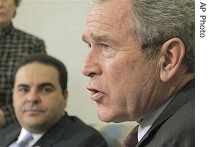 |
| President Bush |
The accusation5 led to a rift6 in already tense relations. The United States cut off oil supplies to North Korea, and Pyongyang expelled international nuclear inspectors7.
News reports suggest the intelligence community may have overstated the extent of Pyongyang's enrichment activities, but senior intelligence officials deny that was the case.
They say they stand by their original assessment that North Korea was seeking to enrich uranium in 2002. But, they say, since then, it has become harder to assess North Korea's nuclear activities, and to corroborate8 new evidence.
At a hearing Tuesday before the Senate Armed Services committee, Joseph DeTrani, the chief U.S. intelligence official on North Korea, acknowledged the problem. He was questioned by Senator Jack9 Reed, a Rhode Island Democrat10.
REED: "Do you have any further indication of whether that program has progressed in the last six years, one; or two, the evidence, the credibility of the evidence that we had initially11, suggesting they had a program rather than aspirations12?"
DeTRANI: "Sir, we had high confidence, the assessment was with high confidence that, indeed, they were making acquisitions necessary for, if you will, a production-scale program. And, we still have confidence that the program is in existence -- at the mid13-confidence level, yes, sir, absolutely."
DeTrani did not offer a detailed14 explanation for the shift from a level of high confidence to one of mid confidence, terms used by intelligence professionals to grade the certainty of their conclusions. But a look at recent history provides some clues.
Since 2002, U.S. and Pakistani officials have dismantled15 the secret network set up by A. Q. Khan, the former head of Pakistan's nuclear program. The Khan network is believed to have sold nuclear know-how16 to the North Koreans. And intelligence sources may have been lost, when the Khan network was broken up.
The White House, meanwhile, is downplaying the notion it might have overstated North Korea's nuclear capability in 2002. Spokeswoman Dana Perino says North Korea is "an opaque17 regime." She also points to the fact that Pyongyang tested a nuclear weapon last November. That test did not involve enriched uranium, but another material, plutonium.
All this comes at a time when the Bush administration is facing questions about its assessments18 of Iran's nuclear capabilities. It is also faced with constant reminders19 of the flawed intelligence regarding weapons of mass destruction that was used to make the case for the March 2003 invasion of Iraq.
 收听单词发音


