2007年VOA标准英语-US, Japan Urge North Korea to Shut Down Nuclear
搜索关注在线英语听力室公众号:tingroom,领取免费英语资料大礼包。
(单词翻译)
By Stephanie HoWashington
27 April 2007
President Bush and visiting Japanese Prime Minister Shinzo Abe say they see eye-to-eye on North Korea. The two leaders are urging Pyongyang to shut down its nuclear weapons programs or face tougher action. VOA's Stephanie Ho reports from Washington.
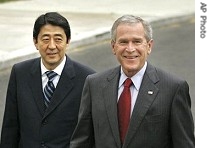 |
| Shinzo Abe, left, and George W. Bush 27 Apr 2007 |
The talks were wide-ranging, covering issues like the steadfastness1 of the U.S.-Japan alliance, cooperation on international issues, nuclear energy and trade.
At a joint2 news conference, the two leaders showed their comfort with each other by repeatedly using each other's first names, George and Shinzo. President Bush said North Korea dominated much of the discussion.
"We spent a lot of time talking about North Korea and our mutual3 desire for North Korea to meet its obligations," said President Bush. "Our partners in the six-party talks are patient, but our patience is not unlimited4. We expect North Korea to meet all its commitments under the February 13 agreement, and we will continue working closely with our partners."
The six-party talks involve the United States and Japan as well as North Korea, China, South Korea and Russia. In February, the six countries reached an agreement under which Pyongyang is to shut down its main nuclear facility and permit international inspectors5. If Pyongyang meets deadlines for dismantling6 its nuclear program, it would receive substantial energy aid. However, the process was thrown into question after Pyongyang missed an April 14 deadline to begin shutting down its facilities because of a dispute over North Korean assets frozen in a Macao bank.
Prime Minister Abe called on the North Koreans to, in his words, "keep their promise." He spoke7 through an interpreter.
"They need to respond properly on these issues. Otherwise, we will have to take a tougher response on our side," said Mr. Abe.
On other issues, the two leaders showed solidarity8 on international sanctions against Iran and ongoing9 reconstruction10 efforts in Iraq. President Bush pointed11 out that Tokyo is the second largest international donor12 to Iraqi reconstruction, after the United States.
The two leaders talked about working together to combat climate change and promote alternative energy resources such as nuclear energy and biodiesel fuels.
The two leaders also touched on the international outrage13 set off by the Prime Minister's denial that the Japanese government or military were directly involved in kidnapping women who were then forced to serve as prostitutes for Japanese troops in Asia during World War Two. President Bush called the so-called "comfort women" issue "a regrettable chapter in the history of the world." But he said he had a heart-to-heart talk with Prime Minister Abe and that he accepts the Japanese leader's apology.
Meanwhile, President Bush urged Japan not to be afraid of U.S. beef imports.
"It's good beef," added Mr. Bush. "It's healthy beef. As a matter of fact, I'm going to feed the Prime Minister's delegation14 a good hamburger today for lunch."
U.S. beef exports to Japan were about $1.4 billion a year until several cases of mad cow disease were discovered in the United States in 2003. After intense negotiations15, Japan agreed last year to accept beef from specially16 certified17 U.S. exporters. For 2006, U.S. beef sales to Japan stood at $66 million.
After the U.S. visit, the Japanese leader travels to the Middle East.
 收听单词发音


