2007年VOA标准英语-Mali's President Amadou Toumani Touré Wins Seco
搜索关注在线英语听力室公众号:tingroom,领取免费英语资料大礼包。
(单词翻译)
By Naomi SchwarzDakar
03 May 2007
Official results in Mali's presidential election on Sunday give victory to the incumbent1, Amadou Toumani Touré. Losers in the poll have alleged2 wrongdoing, but observers said the poll was well conducted. Naomi Schwarz has this report from VOA's West Africa bureau in Dakar.
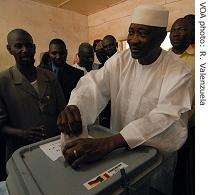 |
| President Amadou Toumani Touré votes, 29 April 2007 |
The final results show President Amadou Toumani Touré (commonly called by his initials ATT) has been elected to a second term in Mali with nearly 70 percent of the votes. He had claimed victory Monday, based on partial results.
Kissy Agyeman of the British-based research group Global Insight says Mr. Touré's victory was expected.
"I think ATT's win has come with little surprise," she said. "It really has been touted3 as a forgone4 conclusion because he is someone who is quite genuinely liked on the ground in Mali. I think people are quite nostalgic as to the improvements ATT has brought. He [brought] multi-party politics to the country in 1991."
Mr. Touré led a coup5 in 1991 to overthrow6 a military dictatorship. He handed power to the democratically elected president the following year, and only returned to power after being elected in 2002.
Agyeman says the only surprise this election is the president's large margin7 of victory. While many analysts8 predicted Mr. Touré would be the eventual9 winner, they believed the election would have to go to a second round. Mali's laws require a second round if no candidate wins an absolute majority of the vote.
Now that the official results are in, the next and final step is that they have to be approved by the nation's top court.
Turnout for the election was low, especially in the capital, Bamako. Only 36 percent of Malians voted. This is approximately the same percentage as voted in the first round election in 2002.
Some opposition10 leaders have made charges of ballot11 tampering12 and fraud, but international observers deemed the election valid13.
Mr. Touré has pledged to continue the policies he began in his first term.
Agyeman says the most important order of business will be working on the economy.
"It is a very narrow economy and it relies very heavily on primary commodities, gold and cotton," she explained. "So I think ATT should focus on how to diversify14 Mali's economy and really bring out the country from the economic difficulties that it sees itself in at present."
Mali is the world's third-poorest country, according to the U.N. Human Development index. The country suffers from chronic15 water shortages, and most residents live in rural areas without running water or electricity.
 收听单词发音


