2007年VOA标准英语-Critics Say Cambodia Oil Revenues May Curse Rat
搜索关注在线英语听力室公众号:tingroom,领取免费英语资料大礼包。
(单词翻译)
By Rory ByrnePhnom Penh
15 May 2007
Revenues from large deposits of oil and gas discovered in Cambodia's territorial1 waters are expected to start flowing by the year 2010. The government says the funds will be used to pay for much-needed infrastructure2 projects and to cut borrowing. But as Rory Byrne reports from Phnom Penh, some critics are warning that oil money could fuel corruption3 and undermine economic development rather than benefit the country.
The exact amount of oil and gas lying off Cambodia's southern coast is still being assessed, but it is substantial. Last month, a Chinese exploration company announced it has found about 230 million barrels of oil plus half a trillion cubic feet of natural gas in just one of Cambodia's six exploration blocks. Other Asian companies and the U.S. oil giant Chevron4 are also exploring.
The oil could mean millions, and perhaps billions, of dollars for Cambodia's small economy each year. The government says the money will go into the central budget for development projects, to pay civil servants and to cut state borrowing.
But some development experts say there is a danger that Cambodia could be dragged deeper into poverty and corruption by what some call the oil curse.
Corruption is already widespread in Cambodia, and revenues from other state-owned natural resources including timber and precious stones have gone into private pockets. Ek Siden is the Development Issues Program Coordinator5 for the NGO Forum6 on Cambodia, representing more than 70 international and Cambodian non-governmental organizations.
"The institutions in Cambodia is very weak, and power is centralized - just only with one-man-show - and we are afraid that the government will use that budget in another way, not to serve the country and not [to] benefit the society as a whole, it will benefit only a few elites," said Siden.
Economists7 warn that if handled improperly8, oil revenues can fuel corruption and contribute to inflation, which could mean key industries like garment manufacturing lose their competitive edge, pushing up joblessness and poverty.
John Nelmes, the resident representative of the International Monetary9 Fund in Cambodia, says an overhaul10 of the country's financial management systems will be required.
"I think there are big challenges, there's a lot of work to be done. One of the keys is that they have to put in place strong macro-economic management, that means budgetary policy that is sound and that directs money towards productive uses," said Nelmes. "Another key is to ensure that inflation remains11 low and that the economy remains competitive."
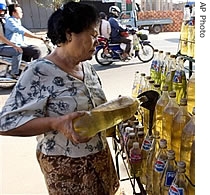 |
| Cambodian Tang Solin, 59, pours gasoline into a smaller bottle at her road-side store in the capital Phnom Penh, Cambodia (File) |
"The government may spend a large amount on the military in order to keep just one-man-show, or keep just in the power, so that is the problem," said Siden. "It's also when there's no transparency of management of the revenue, it also become a conflict in the society"
U.S. Ambassador Joseph Mussomeli says at this stage, it is unclear what the oil revenue will mean for Cambodia.
"I think it's too early to say whether the oil is going to be a curse or a blessing13. The good news is that the Cambodian government is well aware that it could be a curse. And just having that knowledge, being aware of what has happened in other countries, may be enough to forestall14 it here," said Mussomeli. "We are certainly talking to the government, lots of other countries are also offering assistance and guidance. But what it will take ultimately is political will and the political realization15 that the oil could really destroy this country."
To prevent that from happening, the government says that all oil revenue will be channeled through the central budget where it will be used to cut state borrowing, to pay for projects like roads and irrigation and to pay civil servants salaries. Sok Saravuth is the Director of Cambodia's Budget Department. He says that the money will be invested to improve the economy.
"A big lot of investment is needed to push the economy. Only about 5 to 10 percent of the investment required can be afforded by the national revenue. On the order of 80 to 90 percent is funded by grants or loans therefore I don't think we have to worry much that the government has no clear plan or that the money will not [be] used wisely," said Saravuth. "The prime minister has already agreed and decided16 that this oil revenue will be put into the budget."
Some human rights groups are warning that Cambodia may already be on the wrong path. They say there has been little transparency over the awarding of oil exploration contracts and criticize the authorities for not releasing information on the sums of money that oil companies have already paid.
With two or three years to go before the real oil money begins to flow, most agree that there is much work to be done to ensure that oil money is a blessing for Cambodia and not a curse.
 收听单词发音


