2007年VOA标准英语-Tuberculosis Remains a Global Threat
搜索关注在线英语听力室公众号:tingroom,领取免费英语资料大礼包。
(单词翻译)
By David McAlaryWashington
30 May 2007
U.S. health officials have quarantined an airline passenger who may have exposed others to a potentially dangerous form of tuberculosis1. The unusual decision was made after the passenger took flights from the U.S. to Europe, then to Montreal, Canada before reentering the United States. The man has what's called 'Extremely Drug Resistant2' tuberculosis. Passengers and crew from both flights have been urged to be tested for the infection. XDR-tb is an especially virulent3 form of the disease that is resistant to standard drug treatment. Earlier this year, VOA's David McAlary examined the state of TB worldwide and XDR in particular.
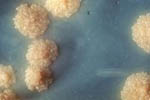 |
| Mycobacterium tuberculosis colonies |
To the director of WHO's Stop-TB Program, Mario Raviglione, the deaths are needless, because a six-month course of drugs that have been around for decades can cure most cases of TB.
"It is a scandal that in 2007 with the means we have, we could potentially cure all drug-susceptible cases of TB, [but] we still see 1.6 million deaths every year, we still see 4500 deaths every day,” he says. “So the point here is, the world must wake up."
But TB persists and mutates into drug-resistant strains harder to cure because many patients fail to finish taking their medicine. The chief of TB research at the U.S. government's National Institute of Allergy5 and Infectious Diseases, Dr. Clifton Berry, says it is a lengthy6 regimen. "In places like Pakistan, and in places like India, and in places like Afghanistan, that's very, very difficult to do, just logistically keeping patients taking medicine for six months."
For years, the World Health Organization has promoted directly observed therapy by local health care workers who go to patients' homes to make sure they take their pills. But in poor countries with weak health systems, health workers to do this are in short supply.
As a result, bacterial7 resistance to at least two common TB drugs is spreading, requiring newer, more expensive, and more toxic8 compounds to do the job.
"One of the biggest challenges is we know it's out there, but we don't know how much of it is out there," says Joann Carter. She is with the non-governmental group RESULTS, which helps fund medical projects in developing countries. She notes that an even more dangerous TB strain has developed recently. The bacterium4 has mutated further into a form resistant to most of the older and newer drugs. This so-called extremely drug resistant strain, or XDR tuberculosis, was first noticed in South Africa, fueled by the HIV epidemic9 that weakens patients' ability to fight such diseases.
Carter calls it a scary superbug that kills 70 to 80 percent of those infected and threatens to reverse progress in treating AIDS. "What you've seen in parts of the world with high rates of HIV is that that drives up TB rates enormously. So when you put together multi-drug resistant TB or extremely drug resistant TB with HIV, it's really a potential explosion of a very deadly disease."
Carter estimates that XDR tuberculosis is still a small portion of the global TB burden.
But WHO official Raviglione warns that without strengthened health and surveillance programs in poor countries, more rapid diagnostic tools, and better, speedier drugs, it could spread. Raviglione says several new compounds are being developed that could shorten therapy by months, but they will not be available for at least three to five years.
The World Health Organization says controlling XDR TB will require an extra $650 million a year from the global community in addition to what it is already being spent. WHO official Mario Raviglione explains. "XDR TB is probably the worst thing that one would ever have imagined. I've been working now in TB control for the last 15, 16 years and I can tell you that this is by far the biggest scare we have ever faced."
Lung specialist Lee Reichman of the New Jersey10 Medical School's Global Tuberculosis Institute argues that new drugs and diagnostic tools will fail if poor countries' health systems are not bolstered11 to deliver them efficiently12. But Reichman says XDR TB is curable with political will and novel thinking. "You have to be ready to think of new things in tuberculosis because what we're doing so far hasn't worked that well."
 收听单词发音


