VOA标准英语10月-EC Chief Presses for Quick Action on US Financial
搜索关注在线英语听力室公众号:tingroom,领取免费英语资料大礼包。
(单词翻译)
The head of the European Commission, José Manuel Barroso has called for swift action by U.S. lawmakers on a massive government rescue plan for failing financial institutions and he urged a global response to the financial crisis that has spread from Wall Street around the world. VOA's Sonja Pace reports from London.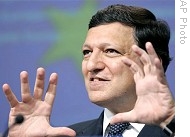 |
| European Commission President José Manuel Barroso speaking in Brussels, 01 Oct 2008 |
Speaking in Brussels, EU Commission President José Manuel Barroso said it is critically important the United States take the lead.
"The U.S. must take responsibility," said Barroso. "I trust that the United States will show the statesmanship that is now required for their sake and all our sakes."
But Barroso said a global response to the crisis is needed.
European central banks have poured billions of dollars into the banking1 systems to provide liquidity2 at a time when banks distrust each other and are unwilling3 to lend from one bank to the next.
But Barroso said liquidity alone is not enough.
"… we also need to inject credibility in the European response and that is why we are asking and urging member states for closer cooperation," he said. "
His comments are the latest of many from political and financial leaders calling for urgent action to stem the crisis.
In Washington, U.S. lawmakers have been wrestling with a major government rescue package for the finance industry.
Talk to many average Britons on the streets of London and they are likely to say the whole financial problem is of America's making. The first ripples4 of the crisis did come from the United States - beginning with the sub-prime mortgage collapse last year and then the more recent collapse of major Wall Street institutions and banks.
But, British economist6 Margaret Bray7 of the London School of Economics says it is a global issue.
"It is not entirely8 of America's making," she said. "These things have been happening in financial centers all around the world, and indeed the big financial institutions are present in every major financial center - in London and Frankfurt and Tokyo and Hong Kong as much as in New York and the world is a very, very interconnected place."
American businesswoman Lisa Montgomery is an education consultant9 in London who advises families who want to send their children to colleges in the United States. She says the financial crunch10 is a major topic of concern among her clients, who come from around the globe.
"I think everyone is incredibly unnerved, almost paralyzed - 'What should I do? Do I stay in the markets? Do I pull out the markets? Do I buy the new car I was thinking about buying? How do I adjust my own behavior today?' - in response to a financial situation, which is so enormous that it is difficult to comprehend and so complex that perhaps only a very small set of people really understand the minutia11 and that is what scares people," she said.
The wider public, particularly in the United States, is also angry at what many see as the high rollers on Wall Street who have amassed12 fortunes in the market while acting13 irresponsibly. And much of the public seems opposed to massive government intervention14 widely seen as helping15 the bankers and brokers16 on Wall Street with money from the wage earners on Main Street.
Lisa Montgomery says such feelings are not quite correct.
"Everyone who plays the markets in any way participates in Wall Street," she said. "Money comes in from all over the globe and people have decided17 to put their money in the markets in hopes of outstanding returns and Wall Street has been delivering outstanding returns for quite some time."
Over the years a growing number of middle class wage earners have participated in the market - including investing money for pension funds and for sending the kids to college.
 收听单词发音


