VOA标准英语10月-UN: Literacy Rates Not Rising Fast Enough
搜索关注在线英语听力室公众号:tingroom,领取免费英语资料大礼包。
(单词翻译)
A new U.N. report warns that not enough progress is being made in raising literacy rates, particularly in Sub-Saharan Africa and parts of Asia. U.S. First Lady Laura Bush was at U.N. headquarters in New York Tuesday to spotlight1 the need for improved literacy, particularly among the world's women. VOA United Nations Correspondent Margaret Besheer has more.The statistics are daunting2, 774 million people worldwide cannot read and write. Two-thirds of them are women. Seventy-five million children do not attend school. And in Africa, only 61 percent of adults can read and write, compared with the world average of about 82 percent.
The United Nations has dubbed3 this the "literacy decade" and the U.N. Educational, Scientific and Cultural Organization, UNESCO, has taken the lead in this campaign to raise world literacy rates.
More than half way to the 2012 target date, the agency has released a report that says literacy rates are rising, but not fast enough. UNESCO has called for an additional $2.5 billion of international funding to help meet adult literacy needs.
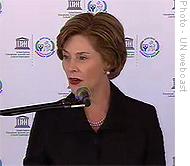 |
| Laura Bush |
The United Nations recently established a new fund to advance the Literacy Decade. At the U.N., First Lady Laura Bush announced that the United States is the first donor4 to that fund, giving a total of $2.5 million.
Mrs. Bush, herself a former teacher and librarian, stressed the importance of improving literacy. "We cannot leave the potential of more than 770 million people untapped. Expanding literacy skills can boost economies with higher wages. It can improve productivity and health, and reduce poverty and crime. Literacy is essential for the sustainable solutions to our greatest problems," she said.
While literacy rates have improved somewhat overall, they have remained virtually unchanged for women. Mrs. Bush, who is an honorary ambassador for the U.N. Literacy Decade, highlighted the importance of closing this gender5 gap. "Reaching women with literacy education is especially important because of the profound impact that women have on their families. If women are educated, everything across the board improves for their families - their family's health, their family's education level, and every other indicator," she said.
The U.N. Literacy Decade aims to improve literacy through policy changes, literacy programs, building capacity for literacy workers, research, increasing community participation6 and monitoring and evaluating progress in various regions.
 收听单词发音


