VOA标准英语10月-Conservatives Win Lithuanian Parliamentary Electi
搜索关注在线英语听力室公众号:tingroom,领取免费英语资料大礼包。
(单词翻译)
Preliminary official results from Lithuania's parliamentary election indicate the main conservative opposition1 party has won the first round of the former Soviet2 republic's parliamentary elections, heralding3 the end of years of Social Democratic rule led by Prime Minister Gediminas Kirkilas. The Homeland Union received about 18 percent of the vote, but the strong support for populist parties is expected to make it difficult to form a coalition4 government. As Stefan Bos reports for VOA, voters also decided5 Sunday on the future of a controversial nuclear power plant in a non-binding6 referendum closely watched by the European Union.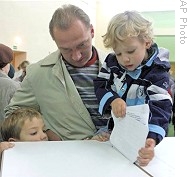 |
| Man, accompanied by his children, casts his ballot7 in Vilnius, 12 Oct 2008 |
The apparent victory of Lithuania's conservative Homeland Union Party in parliamentary elections Sunday came amid voter anger over the Baltic country's economic difficulties after years of spectacular growth.
Difficult talks are expected between the Homeland Union and two populist parties of a former president and a Russian millionaire, that received at least a quarter of the cast ballots8.
The Homeland Union, led by former Prime Minister Andrius Kubilius, is a traditional tax-cutting conservative party but it also says the budget deficit9 could rise and this could mean a delay in the country's attempts to introduce the Euro currency. The party is also the one which most often raises the issue of Russia as a threat to Lithuania.
Yet voters seem to believe that not much will change in their country, whoever comes to power, as they told EuroNews Television.
"If you look at the party programs, they are very much similar, therefore personalities10 on the party lists will decide whom to vote for," one man said.
Under Lithuania's election rules, a second round of voting will be held on October 26, which observers say could still impact the final party line-up.
Whoever comes to power will have to tackle double digit11 inflation and fears the once high flying economy will slide in the global financial crisis.
Sunday's ballot also featured a non binding referendum on whether to keep a controversial Soviet-era nuclear plant operating beyond its scheduled closure in 2009. The Election Commission said the referendum may be invalid12, because of a low turnout, a setback13 for authorities who wanted to pressure the European Union.
EU members want Lithuania's nuclear station to be closed because of design problems similar to those in the Ukrainian plant of Chernobyl, which caused the world's worst nuclear disaster.
European Commission President Jose Manuel Barroso has made clear Lithuania agreed to close the Soviet-era plant by the end of 2009 as part of its deal to join the European Union in 2004.
"There is a commitment, a legal commitment, arising out of the accession treaty that is not at the discretion14 of either Lithuania or the Commission," Barroso said. "This is a commitment that must be honoured as we must never compromise on safety. So I of course, as guardian15 of the treaty at the Commission can only say that the treaties have to be respected."
However Lithuanian Prime Minister Kirkilas has told the EU that Lithuanians would have to face sharp energy rises as a result of the closure of the Ignalina plant, which provides 70 percent of the country's needs.
Observers say many Lithuanians believe that the closure of the plant would make them once again dependent on Russia. Lithuania broke away from the Soviet Union in 1990.
 收听单词发音


