VOA标准英语10月-Congressional Democrats, Economic Experts Discuss
搜索关注在线英语听力室公众号:tingroom,领取免费英语资料大礼包。
(单词翻译)
Majority Democrats2 in Congress met with economic experts on Capitol Hill Monday to discuss a new package of steps to stimulate3 the U.S. economy. VOA's Dan Robinson reports that minority Republicans say they agree on the need for new legislation to help the economy, but call Democrats' proposals insufficient4.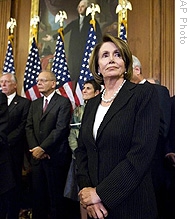 |
| House Speaker Nancy Pelosi (r) at a news conference following an economic forum5 with Democratic leaders and economic experts, 13 Oct 2008 |
As Wall Street experienced a dramatic one day recovery of nearly 1,000 points after last week's sharp declines, Democrats were making clear they intend to take further steps to help Americans battered6 by recent financial market losses, and reform financial markets.
House Speaker Nancy Pelosi and other key Democrats met behind closed doors with a group of economic experts, and afterwards Pelosi summarized what a new stimulus7 package would include.
"A recovery package will have some of the features we have had before, about infrastructure8, health care, aid to the states for health for children and seniors, food stamps and unemployment insurance in this time of rising unemployment," said Nancy Pelosi.
Pelosi was non-committal when asked about how much this would cost, saying more clarity will come from congressional hearings before and after the November 4th U.S. presidential election.
Steny Hoyer is the House Democratic Majority Leader.
"[Hearings] to look in the very short term, but nevertheless in a considered fashion at what options will best help our economy recover and particularly how best to help those who are most vulnerable and most in need," said Steny Hoyer.
Joseph Stiglitz, recipient9 of the 2001 Nobel Prize for Economics, said there was "remarkable10 agreement" among economists12 who met with lawmakers about the need for a comprehensive recovery program.
". . . not just based on trickle13 down economics, not just giving money to financial markets, but going directly, at least some of the money going directly, to households to meet infrastructure needs, to meet the variety of challenges facing our society today," said Joseph Stiglitz.
In addition, says Stiglitz, the program must be efficient and well-designed, and consistent with longer-term U.S. economic needs and prospects14 for growth.
Arthur Leavitt, who headed the U.S. Securities and Exchange Commission from 1993 to 2001, strongly endorsed15 Democrat1's plans to address financial market and regulatory reforms when a new Congress convenes16 next year.
"We are here [in this financial situation] today not because of what happened in the last year, but because of what happened perhaps over the last two decades," said Arthur Leavitt. "We have an opportunity now to make a difference. And the thrust of everything that happened today was to take a look at that and decide how we will restore investor17 confidence."
Allen Sinai, noted18 economist11 and consultant19 to several U.S. presidential administrations, said there is no doubt that the U.S. economy is in recession.
"Look, the U.S. economy is in recession, the global economy is in recession," said Allen Sinai. "We - Washington and Americans - are working through the most severe financial crisis we have had since the 1930s. I think all Americans know the score."
At the same time, Sinai predicts that with congressional action on financial system reforms, in his words, things will look a lot better by next year.
Massachusetts Democrat Barney Frank, who chairs the House Financial Services Committee discussed what Democrats are calling their "recovery initiative".
"So what we will be doing next year is to adopt the kind of sensible regulation of credit default swaps20 and collateralized debt obligation derivatives21 and those other instruments, which have been un-regulated by conscious choice for the past years, and put rules on them so they do not get out of hand," said Barney Frank.
In a letter to House Speaker Pelosi on Monday, House Republican Minority Leader John Boehner asserted that nothing known so far about Democrat's plans will bring long-term stability to the U.S. economy.
While agreeing on the need for additional steps to get the economy back on track, Boehner repeated Republican calls for capital gains and corporate22 tax cuts, adoption23 of Republican energy proposals, and other measures.
Speaker Pelosi told reporters that Democrats are closely coordinating24 their economic steps with Democratic presidential candidate Barack Obama.
In campaign stops on Monday, Obama laid out in more detail steps he would take to help the economy, including a two year tax break for businesses that create new jobs and a 90 day moratorium25 on home foreclosures.
His Republican opponent, John McCain, told supporters he would do more to help the economy, focusing on steps to halt declines in home values, protect retirement26 funds and freeze government spending.
 收听单词发音


