Earth and Sky:Galactic Rotation 银河系自转
时间:2007-07-30 07:18:49
搜索关注在线英语听力室公众号:tingroom,领取免费英语资料大礼包。
(单词翻译)
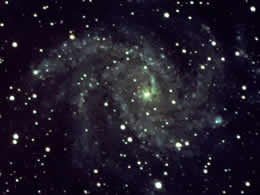
Galactic Rotation1 银河系自转
Astronomers2 calculate there is ten times more matter in our Milky3 Way galaxy4 than we can actually see. Discover how the orbital motions of stars in the galaxy reveal dark matter -- on today's Earth and Sky.
JB: I'm Joel Block.
DB: And I'm Deborah Byrd for Earth and Sky. A listener writes, "I was wondering if the sun (and its solar system) revolve5 around the center of the Milky Way? In other words, does the Milky Way rotate?"
JB: Our sun and solar system orbit the center of the Milky Way galaxy at about 800 thousand kilometers an hour -- that's about 500 thousand miles an hour. So in the 90 seconds of this radio broadcast, we all move some 20,000 kilometers -- or 12,500 miles -- in orbit around the center of the galaxy. But the galaxy is a big place. Even at this blazing speed, it takes the sun about 200 million years to complete one journey around the galaxy's core.
DB: The orbital speed of a star around the center of our galaxy depends on its distance from the center. A star's orbital speed can be predicted from the galaxy's mass, and the star's location. But something mysterious is taking place at distances in the galaxy beyond the orbit of our sun. The speed of these outermost6 objects doesn't decrease as much as expected.
JB: So astronomers think there may be a large amount of undetected mass around our galaxy -- part of the unseen, dark matter of the universe. That's our show for today. Ask your Earth or sky question at our website, earthsky.org. With thanks to the National Science Foundation, I'm Joel Block, with Deborah Byrd, for Earth and Sky.
 收听单词发音


