VOA标准英语2011--Deterring Somali Piracy through Development
搜索关注在线英语听力室公众号:tingroom,领取免费英语资料大礼包。
(单词翻译)
Deterring1 Somali Piracy2 through Development
The U.N. Security Council recently adopted a resolution calling for tougher anti-piracy measures off the Somali coast. One expert says deterring piracy requires a land-based solution with grassroots support.
Assistant U.N. Secretary-General for Political Affairs Taye-Brook Zerihoun recently described international efforts to stop Somali pirates as “unprecedented.” Nevertheless, he said those efforts are “insufficient” and called for greater emphasis on deterrence3, security, rule of law and development.
Action, not just words
“Excellent statements. Question is, what’s going to be delivered to make those things happen? And he’s right. I mean in many ways he occupies a bully4 pulpit, doesn’t he. He’s the sort of person who tries to exhort5 states to do something. He hasn’t got any assets of his own and he needs to draw states into this problem to try and find a solution,” said Dr. Martin Murphy, senior fellow at the Atlantic Council of the United States Ansari Africa Center.
“I think the international community, the international navies, are holding things at the moment. In fact, I’m slightly surprised that the number of attacks hasn’t increased dramatically now that the current monsoon6 season is over. And therefore, one suspects they’re doing something right or something’s changing on the land in Somalia. And to be honest I don’t know what that might be,” he said.
What works, what doesn’t
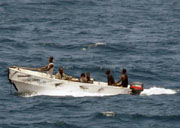 |
| In this U.S. Navy photo, pirates leave the Ukrainian merchant vessel7 MV Faina for Somalia's shore Wednesday, Oct. 8, 2008 while under observation by a U.S. Navy ship. The MV Faina, which was carrying a cargo8 of Ukrainian T-72 tanks and related military equipment, was seized by pirates Sept. 25 and forced to proceed to anchorage off the Somali coast. (AP Photo/U.S. Navy, Petty Officer 2nd Class Jason R. Zalasky) |
Murphy expects attempted ship hijackings in the Gulf9 of Aden and the Indian Ocean to increase as European countries withdraw their patrol vessels10.
“They’ve got so many other claims on their time. Libya has drawn11 off a lot of assets and European nations are under fiscal12 pressure now and they’re cutting their fleets. They’re cutting their government budgets, which is obviously going to happen here, as well. It’s going to affect the United States Navy. It’s happening with the European navies earlier and frankly13 those assets are not being sent back to the Indian Ocean,” he said.
But while international patrols certainly have deterred14 some attacks, other methods have proven more effective.
“To be honest, I think the most powerful deterrent15 has not been the navies. It has been the protected (sic) measures that the ships are taking and the rapid increase in the number of armed guards. The latest figure that’s been suggested to me is that maybe up to 35 percent of ships transiting16 the Indian Ocean Basin are now carrying armed detachments. You know, that is the thing that’s keeping successful hijacks17 down, although it won’t obviously particularly affect the number of attacks that take place,” he said.
However, Murphy said use of armed guards, although successful, is not popular among sailors or maritime18 industry officials.
“The sailors don’t want it because they didn’t go to sea to be fired upon, to have to cower19 in a fire fight. And the ship owners didn’t go to sea to have to carry this additional financial burden,” he said.
Comprehensive approach
A land-based solution, he says, is what’s needed. He proposes a development policy that bypasses government officials and goes directly to community and clan20 levels. This includes women and business groups and local mosques21.
“It’s very important to look at the whole area that piracy is affecting and say those are the stable or semi-stable areas. Those are the areas where we can do development work. Those are the areas where we can get bottom-up projects going. Bottom-up, stress that. It’s not going to be top down through the government where we’ve tried so many times before and they’ve failed or been corrupted22 or led to disputes. We need to get down into that bottom level,” he said.
In addition, he said, well-known piracy kingpins need to be targeted at their regional bases. Murphy says arresting or even killing23 pirates at sea won’t solve the problem.
“We’re picking up, frankly, the expendable, and they are expandable, because apparently24 lots of young men in Somalia are actually dying. They go out at sea and the boat sinks and they don’t get anywhere. We must stop thinking that we can stop piracy by picking up these expendable foot soldiers. There [are] just too many of them. We don’t have the capacity to keep them. It’s the kingpins that are driving this and the economic circumstances that are driving it that we really need to tackle,” he said.
Most nations now view piracy as a criminal act and prefer to address it through the rule of law, not by sinking ships.
Murphy said Somalia is a weak and failed state, and not addressing its security and development issues will only allow problems to fester. He said one example of this is the Pakistan-Afghanistan border. He recommends looking at the problems faced by the entire Horn of Africa.
 收听单词发音


