VOA标准英语2011--US Iraq Withdrawal May Tempt Iran to Fill Void
搜索关注在线英语听力室公众号:tingroom,领取免费英语资料大礼包。
(单词翻译)
US Iraq Withdrawal1 May Tempt2 Iran to Fill Void
The Obama administration’s decision to pull all U.S. troops out of Iraq by the end of this year could tempt Iran to try extending its influence there, analysts4 say, triggering increased tensions with Saudi Arabia as well as the United States.
President Obama announced the troop withdrawal plan last month after his negotiators were unable to reach agreement with the Iraqi government to keep a small contingent5 of U.S. troops in the country for a longer period. Washington also had sought to keep a few permanent bases in Iraq, but the talks broke down when Baghdad refused to grant U.S. troops immunity6 from prosecution7 in Iraqi courts.
George Friedman, chief of the private intelligence firm Stratfor, says Iran sees the U.S. withdrawal as an opportunity.
“The Iranians have made it very clear that they regard the American withdrawal as a vacuum and that they intend to fill the vacuum,” says Friedman.
And Friedman says such an Iranian move would surely stir up trouble with Saudi Arabia, its strategic rival in the region.
“We have seen some substantial tension emerge between Saudi Arabia and Iran,” says Friedman, “including of course the story that Iranian operatives were planning to assassinate8 the Saudi ambassador to the United States and destroy the Saudi Embassy.”
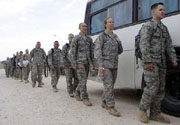 |
| US service members queue to board a bus as they begin their journey home at al-Asad Air Base west of Baghdad, Iraq, November 1, 2011. |
Aware of such troubling possibilities, U.S. officials have sought to make it clear a U.S. troop withdrawal from Iraq does not mean Washington is abandoning the region.
“For Iran and anybody else who has any ideas, let me make clear that the United States maintains 40,000 troops in that region, 23,000 in Kuwait, and numbers of others in countries throughout that region,” says Defense9 Secretary Leon Panetta. “Let me make clear to them and anybody else that America will maintain a presence in that part of the world.”
Published reports say policy makers10 in Washington are already discussing the possibility of bolstering11 the American military presence in the Gulf12 region. Options reportedly under consideration include stationing additional troops in Kuwait and deploying13 more naval14 warships15 in the area’s international waters.
Concern about Iran’s ambitions and influence in Iraq is longstanding, dating back to even before the U.S. invasion of Iraq in 2003.
Analysts say the country in the region most nervous about Iran’s regional ambitions is Saudi Arabia.
While Iraq and Iran both have sizeable Shi’ite Muslim majorities, Saudi Arabia, a hereditary16 monarchy17, is predominantly Sunni Muslim. Analyst3 Alex Vatanka of the Middle East Institute says that if there is a conflict in the Middle East, Iran and Saudi Arabia are bound to be on opposite sides.
“Saudi Arabia supported Saddam Hussein against Iran, and that’s sort of the big beginning in many ways of the conflict between Tehran and Riyadh,” Vatanka says. “You’ve had Iranian-Saudi rivalry18 in Afghanistan in the 1990s. You see that today in Lebanon, in support for the various Palestinian factions19. They oppose each other. And Iraq would be no different.”
Vatanka adds that Iraqi Shi’ites feel estranged20 from the larger Arab world, which is predominantly Sunni Muslim like Saudi Arabia.
“In effect what has happened is that Iraqi Shias have been left with few options,” says Vatanka. “They are pushed into the arms of Iran because instead of being seen as Arabs, they’re first seen as Shias because Saudi Arabia tends to play that sectarian card.”
But analysts wonder how much energy Iran has to devote to Iraq. They point out that Iran is preoccupied21 by internal problems such as the international sanctions imposed because of nuclear program and the deepening political splits among the ruling elite22, particularly between President Mahmoud Ahmadinejad and Supreme23 Leader Ali Khamenei.
 收听单词发音


