VOA标准英语2011--Exhibit Enlists Visitors in Helping Abused Women
搜索关注在线英语听力室公众号:tingroom,领取免费英语资料大礼包。
(单词翻译)
Exhibit Enlists1 Visitors in Helping2 Abused Women
There is a Chinese saying that “women hold up half the sky,” yet in many societies, the contributions of women are ignored and women are often the victims of sexual violence and abuse.
Husband-and-wife journalists Nicholas Kristof and Sheryl WuDunn documented some of those women’s stories in the 2009 book Half the Sky.
The exhibition at the Skirball Cultural Center features stories of women who have taken action to change their lives: Saima Muhammad, a Pakistani woman who built an embroidery3 business with a $65 dollar micro-loan and gained financial independence from her abusive husband and Goretti Nyabenda, a woman in Burundi, who started a business brewing4 banana beer to provide for her family.
It also shows women who have made a difference on a wider scale, including Edna Adan Ismail, the former first lady of Somalia. She is a former nurse who has campaigned against female genital mutilation and used her life savings5 to build a maternity6 hospital in Somaliland.
Their stories are told through photographs, art works, and recorded sights and sounds.
Columnist7 issues moral challege
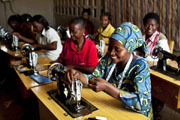 |
| Women who have enrolled8 in international's programs in Rwanda and the Democratic Republic of the Congo are shown sewing. |
In his columns in the New York Times, journalist Nicholas Kristof has described sex trafficking, denial of education and other abuses of women, and he says the exhibit conveys several important themes to visitors.
“We hope that they will take away an appreciation9 that one of the central moral challenges for the world today is this oppression that is the daily lot of so many women and girls around the world. Second, that if one wants to bring about positive change in a lot of countries, then using women as a catalyst10 for change tends to work better than most other approaches," Kristoff adds.
The display features women and girls in Africa, India and Latin America. Kristof knows these people well and has written about them, but says it is emotionally moving to see them as part of this large display.
“It is a very strange and wonderful feeling to walk through this exhibit and see these people, who I’ve known for years, who I've sometimes met when they were just in terrible circumstances," Kristof says. "I look over there and I see a young woman who I saw for the first time in a brothel in Cambodia.”
Tales of oppression
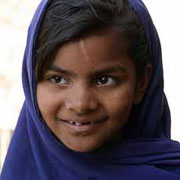 |
| This photograph shows a young Pakistani girl, Javaria, who is now attending school. |
A photograph shows two Cambodian teenaged girls who had been lured11 into prostitution. Kristof paid the brothel owners several hundred dollars to buy their freedom. One went on a new life. The other, addicted12 to drugs, would later return to the brothel.
There are tragic13 stories of women who died in childbirth, a serious problem in many developing countries. They include a Ugandan woman surgeon beloved in her town, who is memorialized in a pennant14.
But there are also glimmers15 of progress. In one photo from Hyderabad, India, boys and girls are shown praying before eating. They are at an education center dedicated16 to preventing sex trafficking and rehabilitating17 survivors18.
Some narratives20 have been captured in sound. Recording21 artist Ben Rubin created audio-visual displays of women held hostage as commercial workers or domestic servants in Los Angeles.
The recordings22 were made with help from the narrative19 history group StoryCorps. Rubin says the women are told they cannot leave until they repay their travel costs to come here.
“And you owe us $12,000 for all the expenses that brought you here, so you’ll work for us for 10 years without pay. This kind of a typical story." he says.
Consulting curator Karina White says these are not isolated23 cases, and that women face serious problems in many parts of the world.
“Women dying in childbirth, violence that’s perpetuated24 against girls and women is really prevalent and completely debilitating25 to women, especially in the poorest countries, and human trafficking,” says White.
Visitor Jay Segal, a retired26 immigration judge who has heard many similar stories during hearings for people requesting political asylum27, is not surprised by any of the accounts in the exhibit.
“Not at all," he says. "But I’m happy to come, I’m happy to see and listen to what’s going on, and I think we have to do a lot more than we’ve done, although we’ve done a lot. And I hope more things happen.”
Visitors empower abused women
Nicholas Kristof says this is also a story of hope and that change is happening, even here in Los Angeles.
Visitors to the exhibit “Women Hold Up Half the Sky” are each given one dollar to invest in a woman's business somewhere in the world. They can make the investment on a computer at the center, connected to an Internet-based micro-loan site.
 收听单词发音


