2006年VOA标准英语-Complicated Saddam Case Raises Concerns
搜索关注在线英语听力室公众号:tingroom,领取免费英语资料大礼包。
(单词翻译)
By Jim Randle
Irbil, Iraq
22 September 2006
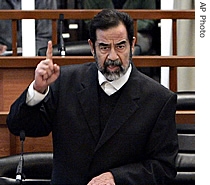 Former Iraqi President Saddam Hussein argues with a judge (file photo) |
||
-----
Here in the Kurdistan Region in northern Iraq, residents follow the case closely on television. Much of the trial's recent testimony consisted of Kurdish witnesses describing their often horrible experiences, suffering burns and blindness from chemical weapons attacks. Later defense3 attorneys tried to cast doubts on the witnesses' credibility.
Human Rights Watch, which gathered evidence used in the case, has expressed concerns about the capacity of Iraq's court to meet international standards of justice and render a fair verdict. Those concerns may have been heightened this week when Iraq's government dismissed the Chief Judge for failing to be neutral and being too sympathetic to the defendant4.
Human Rights Watch's International Justice Program Director Richard Dicker says the court must be particularly skillful because genocide is a difficult crime to prove.
"Because it has this requirement that the prosecutor5 must show that the accused was motivated by or acting6 with very specific intent to eliminate a target group on the basis of either their ethnicity, their religious beliefs or their nationality, not because they were political opponents," he said.
The Kurdistan Regional Government's minister for extra regional affairs, Mohammed Ihsan, also gathered evidence in the massive case. He says the defendants7 are trying to excuse their actions by saying they were necessary in a time of war.
But Ihsan says even war has rules and limits.
"War does not mean chaos8 [is justified], war does not mean killing9 civilians10 [is acceptable], it does not mean killing children and women, does not mean using chemical weapons. War does not mean demolishing11 whole cities. War does not mean destroying 4,000 villages," he said.
Ihsan says he also worries that Iraq's underdeveloped legal system may not be strong enough to render a fair verdict in such a difficult and complex case.
Saddam, his cousin Ali Hassan al-Majeed, known as "Chemical Ali", and five others face chages of war crimes and crimes against humanity for their roles in the 1988 Anfal campaign in northern Kurdistan. Prosecutors12 say the attacks killed 182,000 Kurds with poison gas and other weapons. Saddam and Majeed also face charges of genocide.
Ihsan says the trial is a step toward justice, but real justice may have to wait for God.
"In this life there is no complete justice, nowhere is there complete justice," he added.
A conviction could mean death by hanging for the defendants.


