2006年VOA标准英语-US Report Encourages Research on Native African
搜索关注在线英语听力室公众号:tingroom,领取免费英语资料大礼包。
(单词翻译)
By David McAlary
Washington
01 November 2006
A panel of scientists says African hunger, malnutrition1, and rural poverty could be lessened2 if researchers could improve native vegetables well suited to difficult growing conditions. Africa is home to hundreds of crops tilled in villages, but neglected by scientists.
-----
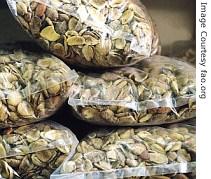 Egusi seeds |
||
The U.S. National Research Council, an advisory3 body to the government, says powerful tools for tackling many of sub-Saharan Africa's basic problems could spring from the ground.
A panel of experts appointed by the council says the region is home to hundreds of indigenous4 vegetables that have fed Africans for tens of thousands of years. Most of these plants are resilient enough to thrive in poor soil and well suited to the small plots and limited resources of village families. But panel member Calestous Juma of Harvard University says most of these species receive little or no attention from researchers.
"A part of the focus on African agriculture has been on traditional staples5 like rice, wheat, and others that generally originate from outside the continent," he said. "Not enough technical attention had been given to crops that originate from the continent itself. That's why we thought the best way to broaden Africa's food base is to focus on identifying crops that originate in Africa."
The National Research Council report entitled "The Lost Crops of Africa" says greater effort to explore the potential of such half-forgotten edibles6 could lead to enhanced agricultural productivity, more-stable food supplies, and higher incomes in rural areas across the continent.
Juma, a native of Kenya, says the better-known imported crops like rice or corn do not grow well in many areas of Africa, making plants acclimated7 to the region important.
"And secondly8, you have people in many areas of Africa who can't afford to import rice or wheat," he added. "Therefore, enhancing the productivity of traditional crops will give them the sufficiency in food production that they need."
The report examines the promise of 18 African vegetables, saying they can help feed the continent's growing, often malnourished population and spur development. They were selected from hundreds of ancestral plants to be the most promising9. These native vegetables - including amaranth, cowpea, and egusi - are still cherished in many parts of Africa.
But the National Research Council study says that because these local plants are ignored by scientists and policy makers10, information about them is often outdated11 and difficult to find. Despite this neglect, the report emphasizes that the vegetables have merit.
Amaranth, for example, is rich in protein and other nutrients12, and grows so fast that the first harvest can sometimes be gathered only three weeks after planting. The bambara bean can grow in very hot, dry climates and produces seeds so nutritionally balanced that the report says some consumers claim they could live on them alone.
This is the second National Research Council report on native African crops. The first in 1996 examined grains. Calestous Juma says it brought significant attention to native African sorghum13 and millets, which science has improved and which are now exported.
"That report had a significant impact on raising the profile of African crops and demonstrating that the continent had a biological resource base that could be used to expand not just Africans' food base, but also contribute to the global food basket," he noted14.
Juma says this is important not only to rural African nutrition and income, but also to the world's ability to endure potential global warming.
"One of the reasons why I think this is significant is because of the recognition of significant ecological15 change, some of it arising from climate change, that is going to demand that we diversify16 our food base to be able to provide global security," he said. "This is where I think Africa could make some contributions."
A third report on native African crops will focus on fruits in a few months.
 收听单词发音


