2006年VOA标准英语-Thailand's Interim Leader Explains Mandate in S
搜索关注在线英语听力室公众号:tingroom,领取免费英语资料大礼包。
(单词翻译)
By Roger Wilkison
Bangkok
07 November 2006
Thailand's interim1 prime minister, Surayud Chulanont, says that, over the next 12 months, his government will try to reform Thai politics, restore national unity2, deal with income inequalities and reestablish the rule of law. In his first address to the international community, sought to explain why the country's military considered it necessary to oust3 the twice-elected government of former Prime Minister Thaksin Shinawatra on September 19.
-----
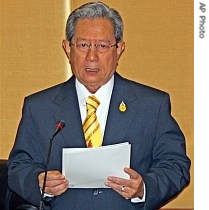 Thailand's interim prime minister Surayud Chulanont |
||
Mr. Surayud, a former army commander appointed as head of government by the military 12 days after the coup5, says the ruling military government will decide when to lift martial6 law.
Addressing international criticism that the coup was anti-democratic, Mr. Surayud says Mr. Thaksin's five-year administration may have been democratic in form, but not in content.
"It was the camouflage7 of electoral politics subverting8 the true democratic principles of the rule of law, justice for all, honesty and transparency in government, and respect for human rights," said Mr. Surayud.
When it removed Mr. Thaksin from power, the military claimed that the former telecommunications mogul had polarized the population, abused power and engaged in corrupt9 practices. Mr. Surayud says Mr. Thaksin's Thai Rak Thai party violated its mandate10.
"This subversion11 of democratic principles was not the mandate given to the government by the people,” added Mr. Surayud. “Rather, it was a mandate unilaterally shaped by a political party that pulled together unprecedented12 political and financial power, power so great that all the checks and balances so carefully built into the 1997 constitution were neutralized13."
Mr. Surayud also criticized the Thaksin government for its hard-line policies toward a raging three-year-old Muslim insurgency14 in Thailand's far south. He called bringing peace to the area, whose mostly ethnic15 Malay inhabitants have long complained that they are treated as second-class citizens, the most important priority for national unity. But he says a solution will not be easy.
"Decades of neglect and injustice16 followed most recently by five years of politically motivated, ill-conceived meddling17 and strong-arm tactics cannot be erased18 overnight," said Mr. Surayud.
Just last week, Mr. Surayud apologized to Muslims in the south for the Thaksin government's actions and said he was willing to hold talks with the rebels. His only condition, he said Tuesday, is that the region should not be separated from the rest of Thailand.
Just before Mr. Surayud spoke19, the authorities in the south reported that five more people had been killed by suspected insurgents20. More than 1,700 people have died as a result of the violence in the region.
 收听单词发音


