2006年VOA标准英语-Bangladesh Makes Progress in Providing Sanitati
搜索关注在线英语听力室公众号:tingroom,领取免费英语资料大礼包。
(单词翻译)
By Anjana Pasricha
New Delhi
12 November 2006
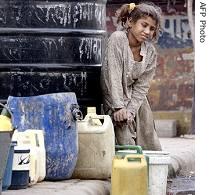 Indian girl collects drinking water from a tank at a slum in New Delhi (File photo) |
||
----
Less than one-third of Indians have access to sanitation, according to the recent report prepared by the United Nations Development Program. The situation is even worse in neighboring Pakistan, especially in teeming2 cities like Lahore and Karachi. The result: more than half-a-million people in these two countries die every year from water-borne diseases like diarrhea.
Arunabha Ghosh, one of the writers of the U.N. report, says the lack of access to sanitation and clean water also creates an enormous drain on the growing economies of the South Asian region.
"Thirty-six-billion dollars is lost due to productivity losses or increased health costs because of the number affected3 by water-related diseases," said Ghosh. "So, for a fast growing region like South Asia, there is a huge economic waste that can be countered by addressing this problem."
But the U.N. says an even poorer country, Bangladesh, has demonstrated that the situation can be dramatically different.
Less than a decade ago, Bangladesh had one of the worst records for sanitation in rural areas. Then more than 600 non-profit groups in the country got together to launch what is known as the "Total Sanitation Campaign."
Ghosh at the U.N. says the program involves a three-step strategy to make individuals understand the crucial role that sanitation plays in preventing disease.
"The first of it is disgust. Community leaders take other members of the community around the slum to create disgust about human and animal excreta," said Ghosh. "The second is increasing awareness4 about what that means for health, so individuals themselves realize how this impacts their life chances."
"And then the third step is mobilizing both community resources and government resources to provide low-tech sanitation facilities," continued Ghosh. "Bangladesh has become a world leader in building low-tech toilets, which are cheap and affordable5."
The successful community-based program led to the creation of sanitation facilities across thousands of villages and urban slums. It has now been scaled up into a national project, and aims to achieve nationwide sanitation coverage6 by 2010.
The U.N. says the same community model is being attempted in parts of India, China and Cambodia, but needs to be broadened to cover larger parts of these countries.
 收听单词发音


