2006年VOA标准英语-Nobel Laureate Friedman Dies at 94
搜索关注在线英语听力室公众号:tingroom,领取免费英语资料大礼包。
(单词翻译)
By Paul Francuch
Chicago
16 November 2006
Professor Milton Friedman, hailed by some as perhaps the 20th century's greatest champion of capitalism1 and economic freedom, is dead at the age of 94.
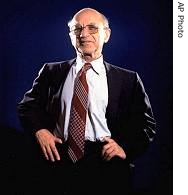 Dr. Milton Friedman, 1976 Nobel Prize winner for economics, poses for a photo in 1977 |
||
Born in New York to poor Jewish parents, Friedman displayed brilliance7 in mathematics at a young age, winning a scholarship to Rutgers University in neighboring New Jersey8. Intrigued9 by the field of economics, Friedman went on to do graduate work at the University of Chicago, the home of some of the nation's leading conservative economists10 of the time.
While at Chicago, he married fellow graduate student Rose Director. Following World War II, Friedman earned his doctorate11 at Columbia University, then returned to Chicago as a faculty12 member.
While championing the cause of the free marketplace, Friedman faced much opposition13 from his fellow economists who believed in the teachings of liberal British economist John Maynard Keynes. The United States government under President Franklin Roosevelt spent its way out of the great depression of the 1930s, following the theories of Keynes. Needless to say, Keynes's theories enjoyed remarkable14 popularity.
Yet Professor Friedman and his followers15 at the Chicago school attacked Keynes' sanctioning of government intrusion in the free market. Friedman argued that inflation caused by the government's printing of more money distorts the economy, eventually leading to its collapse16, thereby17 creating an even bigger role for the state in the private lives of its citizens.
He said individualism and freedom of enterprise were the preferable alternatives.
"A free market and maintaining a free market, under conditions where the market is not distorted, is by all odds18 the most useful role a government can play in economic life," said Friedman. "But this requires that government be relatively19 small. When government imposes taxes, when it buys things, spends money, it distorts the terms on which people can trade with one another."
"The most obvious example is in foreign trade," he added, "our government, most of the governments around the world impose restrictions20 on foreign trade. They impose tariffs21, or quotas22, or subsidize exports."
"All such restrictions, all such impositions, interfere23 with the effective operation of the market, prevent people who could benefit jointly24 from trading with one another from doing so. So I go back: the most useful role government can play is to stay out of the details of the market, but establish an effective framework for a free market," he said.
Friedman argued that a free market encompasses25 much more than just economic concerns.
"A free market includes the free exchange of views, the ability to read what people write, regardless of what their views are, the whole area of freedom of speech, of religion, of discussion, of the press, is really an aspect of a free market," he said. "It is an area in which individuals should be free to cooperate with one another, to exchange views, to say what they believe."
Friedman began teaching his laissez faire economic theories at a time when many in his profession scorned such ideas. That is not the case today.
Milton Friedman's students include some of the best and the brightest. He served as an economic advisor26 to several presidents, and his ideas are bound to influence economists and economic policy for many years to come.
 收听单词发音


