2006年VOA标准英语-Palestinian Efforts to Create Unity Government
搜索关注在线英语听力室公众号:tingroom,领取免费英语资料大礼包。
(单词翻译)
By Jim Teeple
Jerusalem
20 November 2006
After weeks of intensive talks, efforts to create a Palestinian unity1 government have stalled. Palestinians hope that, if they can form a new government that is not run by Hamas, international donor2 aid, and even the Middle East peace process could be revived. Israeli policymakers have been skeptical3 of the Palestinian efforts.
----
It was only a week ago that Palestinian President Mahmoud Abbas made a rare visit to the Gaza Strip for talks with Prime Minister Ismail Haniyeh.
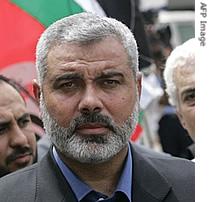 Ismail Haniyeh (File photo) |
||
Haniyeh, a leading Hamas militant4, had offered to step aside, and many believed that Hamas and Mr. Abbas' Fatah faction5 were going to form a new government and end months of feuding6 and conflict. Now those talks have been put on hold - reportedly because Hamas and Fatah have been unable to agree about which faction will control key Cabinet positions like the finance and interior ministries7.
Yossi Alpher is a former Israeli negotiator with the Palestinians, who now edits Bitterlemons.org, a Web site that promotes Israeli-Palestinian dialogue. Alpher says Hamas and Fatah put aside their differences, after Israeli forces mistakenly shelled an apartment complex in the Gaza town of Beit Hanoun, killing8 19 members of an extended family. But, he says, that unity has not been enough to bridge differences between the two sides.
"They still have a long way to go in negotiating agreed guidelines for this government between Fatah and Hamas, guidelines that presumably would be designed to persuade Israel and the international community to change their attitude toward the government - to renew aid, and, perhaps, renew diplomatic contacts," said Alpher.
More concerns about a future unity government were raised last week, when a spokesman for Hamas told reporters that any new Palestinian government would not recognize Israel. nor accept a two-state solution to the Middle East conflict.
International donors9, like the United States and the European Union, as well as Israel, which is withholding10 customs and tax revenue it normally turns over to the Palestinians, say, if donor aid is to be revived, any new Palestinian government must agree to recognize Israel, renounce11 violence and accept previous agreements between Israel and the Palestinians.
Palestinians, such as Ali Jarbawi, a professor of political science at Bir Zeit University in the West Bank city of Ramallah, say, despite the stalled talks, Hamas and Palestinian President Abbas, also known as Abu Mazen, will eventually agree on a new government.
"I think it is going to happen, but it might take some time. I view the time that it is taking Hamas and Abu Mazen [Abbas] and everybody, as a positive sign rather a negative one," he said. "Hopefully, we are going to have a new government, and, hopefully, it will be acceptable - internally and externally."
For their part, Israeli leaders have mostly refrained from commenting about the efforts to form a new Palestinian government.
In recent days Israel has also rejected initiatives from Spain, France, Italy and the Arab League, which have proposed reviving Middle East Peace talks. Israel says the internationally-backed roadmap peace plan is already in place, and that plan needs to be implemented12.
Yossi Alpher of Bitterlemons.org says, these days, Israel's attention is not focused on the Palestinians, but on the potential threat of a nuclear Iran and its allies in the region.
"Israel is preoccupied13 today with Iran and by the Iranian threat posed by Iran's client state - Syria and by its proxies14 - Hezbollah and other anti-Israel movements that it supports, like Hamas," he said. "The focus of attention, or the point of departure for Israeli strategic thinking on our surroundings today is Iran and not the Palestinian issue."
Israel's political and military leadership is also under fire for its conduct of the military conflict with Hezbollah in July and August. Prime Minister Ehud Olmert's election promise to draw Israel's final border with the Palestinians was put on hold after that conflict, and after Palestinian militants15 kidnapped an Israeli soldier and stepped up rocket attacks against Israel from the Gaza Strip.
With Palestinian moves to create a unity government now stalled, and Israel's attention diverted by Iran, it appears that neither side will be offering new proposals to ease tensions and break the cycle of violence in the region anytime soon.
 收听单词发音


