2006年VOA标准英语-Countries Agree to Pursue Fusion Energy Researc
搜索关注在线英语听力室公众号:tingroom,领取免费英语资料大礼包。
(单词翻译)
By David McAlary
Washington
21 November 2006
The United States and more than 30 other nations have signed a $13 - billion agreement to develop a form of nuclear power in a process called fusion1. In a Paris signing ceremony, they agreed to cooperate to build an experimental reactor2 intended to mimic3 the way stars make energy, with the hope it can eventually lead to a plentiful4 supply of cheap, clean and safe power.
The consortium brings together the United States, the European Union, Japan, Russia, China, South Korea, and India to build the International Thermonuclear Experimental Reactor, or ITER for short, in southern France.
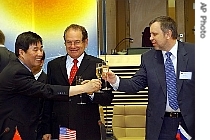 |
| Yanhua Liu, left, Raymond Orbach, center, Vladimir Travin, right, make toast at end of signing ceremony |
"ITER has the potential to free the quickly growing global economy and population from the looming6 constraints7 of decreasing energy supplies and the unfortunate effects of environmental degradation," Orbach said.
ITER began with an agreement at the 1985 U.S.-Soviet Geneva Summit. It was one result of a plan to develop joint8 activities to help reduce Cold War tensions. Other nations joined later.
But Congress ordered the U.S. government to withdraw in 1998 because it considered the original reactor design too expensive. Faced with a sharp drop in the budget, the remaining ITER members redesigned the reactor at half the cost, making it attractive again to the United States, which rejoined in 2003.
Debate over the location of the project was another source of political friction9. France and Japan both wanted it, but the partners agreed on France last year. In return, Japan pays lower construction costs and gets more staff, including the post of ITER director-general.
Now that the agreement is final, Raymond Orbach says the consortium can pursue development of the energy that powers stars.
"The fusion process is one of the most powerful ways of producing energy that nature has devised," he explained. "As examples of that, I simply suggest you look at the stars and realize how our sun is powered. So what we are trying to do is to take advantage of this quite remarkable10 property of nature that literally11 keeps us alive."
In fusion, the nuclei12 of light elements, such as hydrogen, fuse together inside stars to make heavier elements, such as helium. The fusing process gives off tremendous amounts of energy.
Using fusion to generate power, there would be none of the greenhouse gas byproducts of the sort fossil fuels emit. Nor would fusion produce radioactive material as does the other form of nuclear energy, called fission13. The source of hydrogen for the energy-producing reaction would be water.
The ITER reactor will use doughnut-shaped magnetic coils to induce an electric current in a mixture of charged particles, making conditions hot enough to create fusion reactions like those inside stars.
Environmental groups oppose the project. At the Washington branch of Friends of the Earth, Eric Pica says the program is a tremendous waste of money for the slight hope of producing fusion energy.
"You can make better investments by investing in renewable energy and energy conservation," Pica said. "We know these things will save energy and reduce our fossil fuel dependence14 now."
But Raymond Orbach, the U.S. Department of Energy's science director, says not pursuing fusion research would be an outrage15.
"We would be telling our world population that they do not have a chance of achieving the standard of living that the rest of us enjoy," Orbach said. "That is how serious it is if we do not pursue this opportunity."
Plans call for the eight-year construction of the ITER reactor to begin next year. Officials hope to have the unit working by 2040. They predict that if all goes well, fusion could provide 10 to 20 percent of the world's energy by the end of the century.
 收听单词发音


