2006年VOA标准英语-UN Calls for Negotiations in Eastern DRC
搜索关注在线英语听力室公众号:tingroom,领取免费英语资料大礼包。
(单词翻译)
By Naomi Schwarz
Dakar
27 November 2006
United Nations officials in the Democratic Republic of Congo are calling for an end to hostilities1 in the eastern region bordering Rwanda. U.N. peacekeepers earlier intervened to block forces loyal to renegade rebel leader Laurent Nkunda from advancing further after the rebels captured a small town on Sunday. Naomi Schwarz reports from VOA's regional bureau in Dakar.
---
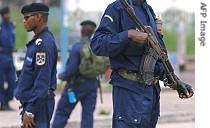 |
| Policemen secure area in center of Kinshasa, 27 Nov. 2006 |
U.N. spokesman Kemal Saiki says that the international organization is appealing for calm.
"We are calling for an immediate2 end to the fighting," Saiki explained, "and we are emphasizing the fact that what brought about this fighting is a political issue, and the political issue, the only way to solve them is to address them through a political solution."
The DRC's Minister of Interior and the deputy head of the U.N. mission there have gone to the region to try to negotiate with the rebels.
When the DRC's civil war ended in 2003, General Nkunda refused to join the newly integrated army. Since then, there have been several clashes with Nkunda's forces.
Nkunda has said that he wants to protect his people, Congolese ethnic3 Tutsis, who he says face persecution4 from the new army.
But Jason Stearns, an analyst5 for the Brussels-based think tank, International Crisis Group, says he does not believe this most recent unrest was not part of a larger strategy.
"The trigger appears to have been the killing6 of a Tutsi civilian7 who was close to one of the commanders in this group," Stearns said. "He was killed at a police checkpoint in the town of Saké just to the west of Goma. So after he was killed, the dissident forces, who are under the command of General Laurent Nkunda launched an attack on the town of Saké."
Goma is a major city near Rwanda's border. In fighting in 2004, Nkunda's fighters had briefly8 taken over the other major eastern city, Bukavu.
Humanitarian9 organizations have accused Nkunda of war crimes and human rights abuses.
The U.N. spokesman Saiki says that only the Congolese government can decide whether to arrest Nkunda.
"I cannot speculate about that. This is a question that should be addressed to the Congolese government," Saiki said.
Congo's capital, Kinshasa, also recently experienced unrest surrounding the results of the October 29 presidential election. Incumbent10 President Joseph Kabila who is popular in the east won the vote, but results have yet to be certified11 amid a challenge by his rival former Uganda-backed rebel Jean-Pierre Bemba.
 收听单词发音


