2007年VOA标准英语-UN Secretary-General: Sudan Must Accept Darfur
搜索关注在线英语听力室公众号:tingroom,领取免费英语资料大礼包。
(单词翻译)
By Peter HeinleinUnited Nations
19 March 2007
U.N. Secretary-General Ban Ki-moon says Sudan must accept a strong international peacekeeping force in its war-torn Darfur region. Mr. Ban made the comment in an exclusive VOA interview. Correspondent Peter Heinlein spoke1 to Mr. Ban, and reports the secretary-general is making preparations for eventual2 creation of a U.N.-backed hybrid3 peace mission.
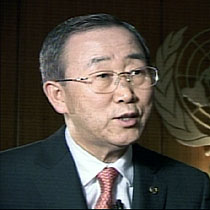 |
| United Nations Secretary General Ban Ki-Moon |
The three-phase Addis Ababa deal calls for Sudan to allow a so-called "heavy support" package of 3,000 well-equipped U.N. military police into Darfur. They would prepare the way for eventual deployment7 of a 21,000 - member hybrid force of U.N. and African Union troops. That force would replace the financially-strapped 7,000 - member AU mission currently in Darfur.
In a letter to Mr. Ban this month, Sudan President Omar al-Bashir appeared to renege on the Addis Ababa deal. But the secretary-general told VOA President Bashir must not be allowed to back out of the commitments made in Addis Ababa, and in an earlier Darfur peace agreement reached in the Nigerian capital, Abuja.
"It was regrettable that President Bashir has made several reservations to my proposals to deploy6 a heavy support package and the hybrid peacekeeping operations," said Ban Ki-moon. "This proposal was done in close coordination8 with the African Union, in accordance with the Addis Ababa and Abuja agreements. This is something they must accommodate."
The secretary general says he will continue to press for a political solution in Darfur that will allow distribution of humanitarian9 aid to desperately10 needy11 people in the region. He has appointed former Swedish foreign minister and U.N. General Assembly president Jan Eliasson as his special envoy12 for the political process. Eliasson will be traveling to Khartoum for talks next week, along with the U.N. humanitarian aid chief, Undersecretary General John Holmes.
In the meantime, Mr. Ban says he is also moving ahead with preparations for the deployment of a military force.
"I have also proposed the nomination13 of the joint14 representative and the force commander," said UN secretary-general. "We have laid out all preparations so we will be able to contribute to the resolution of the Darfur issue."
At least 200,000 people have died since Darfur rebels took up arms against the Khartoum government in early 2003. Some scholars put the death toll15 far higher.
Human-rights activists16 accuse the government of responding by unleashing17 Arab tribal18 militias19 blamed for widespread atrocities20 against ethnic21 African villagers. The government denies the charge.
The United States and some human-rights groups say the atrocities amount to genocide.
More than 2.5 million people have fled their homes to escape the killing22. Some of the violence has spilled over into neighboring Chad and the Central African Republic, where many Darfurians are living in squalid refugee camps.


