2007年VOA标准英语-Cambodia Winning the Fight Against AIDS
搜索关注在线英语听力室公众号:tingroom,领取免费英语资料大礼包。
(单词翻译)
By Rory ByrnePhnom Penh
22 March 2007
On the face of it, Cambodia should be devastated1 by AIDS. Brothels are commonplace in the impoverished2 country, illegal drugs are widely available, and government spending on health care is only about two dollars a person each year. But the rate of new AIDS infections has dropped during the past decade. Rory Byrne reports for VOA from Phnom Penh on how Cambodia is turning the tide against AIDS.
In 1997, 3.2 of Cambodians were infected with HIV, the virus that causes AIDS. The United Nations office dealing3 with AIDS, UNAIDS, says that among sex workers the figure was almost 40 percent.
Today, UNAIDS says only about 1.6 percent of the general population is infected, with about 20 percent of sex workers believed to be infected.
Dr. Mean Chhi Vun is the director of Cambodia's National Center for HIV, AIDS, Dermatology and Sexually Transmitted Infections. He says the key to Cambodia's success has been a multi-faceted plan in which government and aid groups work together at all levels to fight the disease.
"As you may know, Cambodia is one of the poorest countries in the world," he said. "So we work together with all partners - including bilateral4, multilateral, the international finance agencies like World Bank, ADB, the academic institutions, and the civil society including NGOs and community-based organizations."
Cambodia is still recovering from decades of conflict. Thousands of women see no choice but to become sex workers, and the country has a young, migrant population. All of these factors can contribute to rising HIV infection rates.
The U.N. AIDS co-coordinator in Cambodia, Tony Lisle, says the government deserves great credit for having the political will to tackle the disease.
"The Cambodian government basically has opened the space for all the key players to play their role," he said. "The government has essentially5, for example, in terms of the sex work and client environment, the government approved and the prime minister basically established a policy for the 100 percent condom use program in brothels, so it opened the door for a scaled response."
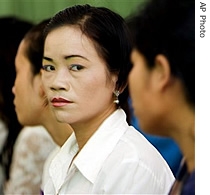 |
| A Cambodian sex worker, second from right, looks on while participating in a group discussion on AIDS in the capital Phnom Penh (File) |
"We try to normalize the condom use in Cambodia by educating them through the CUP (100 percent Condom Use Program) campaign," said Dan Borapich, a spokesman for Population Services International, the largest distributor of subsidized condoms in Cambodia. "You know, use a condom, and also increase the visibility of condoms through our distribution channel, like we try to make sure that condoms available at even supermarket, mini-market, stall, you know, pharmacy8, everywhere."
Another important part of the strategy is treating those infected with cheap or free anti-retroviral drugs.
Tony Lisle of UNAIDS says that about 25,000 patients are receiving treatment in Cambodia - nearly 80 percent of all those who need treatment. The bulk of the life-saving drugs are provided by the Global Fund for Tuberculosis9, AIDS and Malaria10.
"I think Cambodia, of all countries in the region, is a major success story in terms of getting all of those who need to be on treatment, on treatment," said Lisle.
Despite the progress, experts warn there remains11 a chance the infection rate could still rise, particularly among those groups engaging in high- risk behavior. Studies show, for example, that new infections among men who have sex with men and those who use illegal injected drugs are still increasing in Cambodia.
The infection rate also is increasing among so-called indirect sex workers - women working in beer gardens, karaoke clubs and hostess bars.
AIDS experts say these women often have a steady partner and do not use a condom with that man, although neither the woman nor the man may be faithful.
HIV infection rates also are high among men who have moved to Phnom Penh from the countryside to work. These men often become infected at brothels and then take the virus home to their wives.
For many of those infected with HIV, life is difficult. Cambodia's health-care system is basic at best. Conditions are unhygienic. Modern medical equipment is almost non-existent.
And discrimination against AIDS sufferers is commonplace, despite efforts being made to stamp it out.
Mony is HIV positive and works for the Cambodian Community of Women living with HIV/AIDS.
"In the community, stigma12 and discrimination is still happening. Nobody wants to talk to the PLHA - people living with HIV and AIDS - nobody wants to buy their products," said Mony. "So, it is still very hard ... even the stigma and discrimination in the health center and also at the national level ... it is still happening, yeah."
Despite these problems, Cambodia has become an example of how to fight the disease. AIDS experts say the lesson from Cambodia is that if the political will is there from the top, the disease can be contained, even in the poorest nations.


