2007年VOA标准英语-Activists Seek to Save Children from Work in Ke
搜索关注在线英语听力室公众号:tingroom,领取免费英语资料大礼包。
(单词翻译)
By Cathy Majtenyi
Kiambu District, Kenya
11 June 2007
In Kenya's Kiambu District, activists1 and local government and education officials are working hand-in-hand to rescue boys and girls laboring3 in the area's coffee, tea, and other plantations5. Cathy Majtenyi visited Kiambu District ahead of the World Day Against Child Labor2 on June 12th and files this report for VOA.
To all outward appearances, 13-year-old Ruth Wangui is a happy-go-lucky girl who enjoys spending time with her friends during breaks from her classes at Maciri Primary School. But behind Ruth's easy smile are painful memories of her years picking coffee in one of Kiambu District's many coffee estates.
The grade seven student says that from the time her parents brought her to the plantation4 at the age of four to pick coffee until she stopped at the age of seven, she frequently felt ill from the pesticides6 and other chemicals the workers would spray on the coffee plants.
"When I am in school I am feeling very good because I'm not going to pick coffee, and those chemicals cannot affect me when I was in school," says Wangui.
Nineteen-year-old John Vukaya Lumasia is a student at Riabai High School. He says extreme poverty at home pushed him into picking coffee with his mother from the time he was nine until he was 17 years old.
He tells VOA he earned a little over $2 for a nine-hour day of picking coffee beans and he says he suffered a lot of abuse on the job from his employers.
"Sometimes they could have chased you out of coffee (plantation) if you decided7 to pick badly,” says Vaukaya. “Other times they beat you. The majority of them they beat you because they see as if you are disturbing them."
John and Ruth are two of an estimated 1,000 children in Kiambu District who have been rescued over the last four years from working in the area's plantations and taken to school.
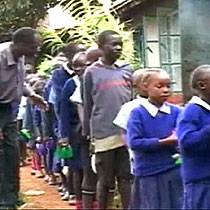 |
| Kenyan school children |
In some cases, families are given money to pay for uniforms, books and secondary school fees. Schools such as Maciri Primary School have lunchtime feeding programs. That meal may be a former child laborer's only food for the day.
Officials say they do not know the exact number of child laborers in Kiambu District. According to a 1998 government survey, 1.9 million of Kenya's 10.9 million children are employed. More than half of these children work on commercial plantations or in subsistence agriculture or fishing.
Many children who are rescued from child labor face enormous challenges as they try to integrate into a regular classroom setting.
James Gathage teaches grades five to eight at Maciri Primary School. He says his school has taken in more than 100 former child laborers within the past few years, and that it is very difficult to retain those children.
"They take time to adjust,” explains Gathage. “Having been used to the life out of school, some are overage, so when you bring them back here, they tend to see as if they are brought back to a level whereby they are not getting money, they have been put in the discipline here, and (because of) the life they have been leading, they are quite different."
Gathage says the former laborers exhibit many adult behaviors and tend to run away from school when it is coffee picking season. Some of the girls, he says, have been sexually molested10 by their employers and even impregnated.
But for children like Ruth, school has been a godsend. Ruth says she wants to be an accountant, and urges all child laborers to return to school to get a better life for themselves and their families.
 收听单词发音


