2007年VOA标准英语-Russian Presidential Contender Predicts High-Te
搜索关注在线英语听力室公众号:tingroom,领取免费英语资料大礼包。
(单词翻译)
By Peter FedynskyMoscow
13 June 2007
Leading Russian presidential contender Sergei Ivanov says his country can become a leading high-tech1 and industrial power by 2020. But as VOA's Moscow correspondent Peter Fedynsky reports, corruption2 and bureaucracy could stifle3 hopes for Russia's economic development.
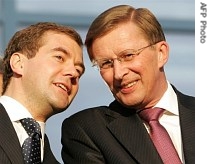 |
| Russian First Deputy Prime Ministers and two potential candidates to succeed President Vladimir Putin, Sergei Ivanov (R) and Dmitry Medvedev, 9 June 2007 |
"We no longer have our own maritime4 fleet," he said. "Only one-third of the ships sailing under the Russian flag were built in Russia. And the absence of effective controls over cargo5 shipments is costing the state billions each year."
On Saturday, Ivanov told a major international economic forum6 in Saint Petersburg that the Russian government will foster innovative7 breakthroughs by creating large state holding companies. The Russian official says these companies will buy out private businesses at market prices and will not engage in any form of protectionism.
But Natalia Volchkova, senior economist8 at Moscow's New Economic School, fears state involvement will also foster corruption.
She says corruption and wasteful9 spending will start the moment the government buys a private business. The government, she says, is the least effective part of any economy, adding that a free market should be a market, not a government.
Volchkova says that foreign investors10 could be skeptical11 about doing business with state- run companies.
She says investors, both foreign and domestic could fear not only the unexpected loss of a license12, but also the threat of such loss, and will not go for any deals with the government.
In a sign of what some analysts13 consider better U.S.-Russian business relations, America' Boeing Aircraft Corporation on Saturday signed a $3 billion deal to deliver 22 airliners14 to Russia's Aeroflot airline. Aeroflot, the former Soviet15 state airline, is now a private corporation. It remains16 to be seen to what extent investors will help support Sergei Ivanov's vision of a high-tech Russia under increased state control. In recent years Russia dismantled17 its centralized Soviet economy. Ivanov's proposal suggests a step toward recentralization.
"The time has come to fundamentally change the situation," he said.
Ivanov spoke18 in this instance about shipbuilding, but if his vision of a high-tech Russia is to be fulfilled within 13 years, change will likely be needed in other major sectors19 of the economy. Investors, and perhaps voters in next year's presidential election will likely have a say in whether greater state involvement in the Russian economy represents needed change.
 收听单词发音


