2007年VOA标准英语-US Congress Hears Many Voices on Iraq
搜索关注在线英语听力室公众号:tingroom,领取免费英语资料大礼包。
(单词翻译)
By Dan RobinsonWashington
15 June 2007
As debate continues over Iraq, U.S. lawmakers have heard from a number of voices including U.S. military officials, and current and former U.S. and Iraqi diplomats2. VOA's Dan Robinson was present during many of the discussions by some of these figures as the battle of wills between the Democratic-led Congress and President Bush over the war in Iraq continues.
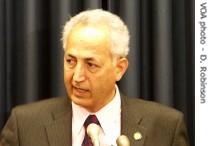 |
| Iraq's Ambassador to US Samir Shakir Mahmoud al-Sumaydi |
The Iraqi diplomat1 used an address to a room full of congressional staffers to lay out what he sees as the stakes in Iraq, for Iraqis, the Middle East, the United States and the world.
Iraq he says is at the epicenter of a momumental confrontation4 between two universes and two sets of ideology5 the outcome of which will have long-lasting impact.
"It is the central line of battle. That is why it is very important what happens in Iraq. It is very important who wins in Iraq, important not only for Iraqis important to every individual in this country. There is a big cost attached to this struggle, but there is likely to be a much bigger cost if it is lost. We have to think of that," he said.
The ambassador's view parallels that of President Bush who describes Iraq as the central battle against al-Qaida, along with Islamist extremism.
Between now and September, the administration and Congress will receive two key reports on progress, or the lack of it, in Iraq and the new joint6 Iraqi/U.S. military strategy, reports that could prove decisive.
Against a backdrop of continuing low public approval numbers for President Bush, and Iraq-related politics in the 2008 U.S. presidential contest, Democratic leaders plan to use legislation to transition U.S. forces away from a combat role, and remove the authority lawmakers gave him in 2002 for military action.
Although he prevailed in forcing Democrats7 to remove troop withdrawal8 language from Iraq funding legislation, cracks in the president's support are seen in statements by Republican leaders that continuing bad news will require the president to change course.
In a VOA interview, North Carolina Republican Sue Myrick says Americans support the cause of democracy in Iraq, but have a limit to their patience as they wait for some sign of progress by Iraq's government in achieving political and economic benchmarks.
"It is their country, they have to be running it, they have to be training their military, they have to stop the sectarian violence, they have to do those things. We are there as backup support and that is what General Petraeus is doing, he is providing the training and backup support. Whether it is going to work or not, I can't tell you. I can just tell you that patience runs very thin and there is a cutoff point for this relative to how much more support we give to them (Iraqis)," she said.
Other voices heard on Capitol Hill include Lieutenant9 General Martin Dempsey, former Commanding General of the Multinational10 Security Transition Command in Iraq.
In describing what he called key capability11 gaps in Iraq's military forces, he said Iraq's leaders are fully12 aware they cannot rely on the indefinite presence of a sizable U.S. force.
"Everyone understands that there will be a declining U.S. presence at some point, to include the Iraqis understand that and they are beginning to ask me how much bigger should they grow in order to offset13 the declining U.S. presence, and the answer to that question is the pace at which we eventually decline," he said.
In separate remarks to Congress recently, President Bush's new coordinator14 for Iraq and Afghanistan, Lieutenant General Douglas Lute15, had this observation on the need for Iraqis to seize the moment for political reconciliation16:
"We are giving them a golden opportunity that they must seize to make progress on the political front. I don't think there is any doubt in the mind of any Iraqi politician that this is an opportunity they have to seize," he said.
This remark by Congressman17 Roscoe Bartlett provided another example of the signals the administration and U.S. military leaders are receiving from Republicans. "Our constituents18 are very uneasy with terms like stick it out and stay the course. They have no idea what that means. If that means we are going to be there 50 years from now, like we are in South Korea, they have got no stomach for that sir," he said.
In testimony19 to the House Foreign Affairs Committee this past week, Former Secretary of State Lawrence Eagleburger, who was a member of the independent Iraq Study Group, said a U.S. withdrawal under what he called adverse20 circumstances would be a serious mistake:
"I think we all have to understand that when and if we leave Iraq on less than satisfactory terms, the consequences for our position in the world, more this time than Vietnam by a long shot, the consequence is something we are going to have to think about and face. If we leave, clearly having been defeated from beginning to end, if we leave under those circumstances, we will not make up for that in terms of the views of the world and in terms of the threats in that part of the world for some period of time," he said.
Iraq's ambassador refers to what he calls a good performance by Iraq's government under fire noting it has succeeded in establishing the foundations of democracy.
Drawing a comparison between sectarian politics and strife21 in his country, and divisions in the U.S. over Iraq, he hopes American political leaders can at least agree on the need to finish what the United States started:
"We need the United States, which started the process, to stand firm with us. To abandon the fight now would have consequences as I said which go way beyond our borders, because these people, as far as they are concerned, we are only the appetizer22, the main course is this country," he said.
But in a letter, and face-to-face talks with President Bush, congressional Democrats reiterated23 their intention to wind down the war, with the goal of bringing U.S. troops home.
House Speaker Nancy Pelosi spoke24 after a meeting with the president. "We will be having legislation to repeal25 the president's authority to continue the war in Iraq. We will have legislation that speaks to our vision for stability in the Middle East, which is to redeploy the troops out of combat in a civil war and into fighting al-Qaida, to training the Iraqi troops, for [U.S.] force and diplomatic protection in Iraq and to protect our interests in the region," she said.
After the same meeting, Senate Democrat3 Charles Schumer referred to what he called a great divide in the room during the discussion with the president and his advisers26 on Iraq and the Middle East.
 收听单词发音


