2007年VOA标准英语-Nepal Army Defends Itself Against Allegations o
搜索关注在线英语听力室公众号:tingroom,领取免费英语资料大礼包。
(单词翻译)
By Liam CochraneKathmandu
19 June 2007
The Nepal army has defended its human rights reputation in the face of allegations it is responsible for the forced disappearances1 of up to 1,000 people during the country's civil war. The army promises to cooperate with a new high-level commission to investigate the cases, ordered by a recent landmark2 Supreme3 Court verdict. Liam Cochrane has more from Kathmandu.
Halfway4 through Nepal's 10-year civil war, the Nepal army was brought in, to back up the struggling police force in the fight against Maoist rebels.
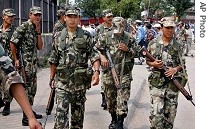 |
| Nepal army soldiers (file) |
The International Red Cross says almost 1,000 of those arrested are still missing.
Sandra Beidas is the chief of protection at the U.N. Office of the High Commissioner6 for Human Rights. She says families of those who disappeared continue to suffer.
"Obviously not knowing whether their loved ones are alive or dead, what happened to them, is just a constant anguish7, and in a sense it's a form of mental torture," she said. "And especially sometimes when the authorities say they were killed in a confrontation8 when the families know very well that they were actually taken away to a military barracks and disappeared from the military barracks."
The army says it is not hiding the whereabouts of the disappeared and says it is serious about reducing human rights violations9 by its troops. A spokesman for the army reports 162 soldiers have been punished for human rights offenses10 since 2001.
Colonel Dharma Baniya is the deputy director of the army's human rights directorate.
"In 2001 when army was mobilized initially11, we had not educated knowledge, to be very frank, at that time we had committed some violations (in) 2001, two (2002), three (2003)," he explained. "After 2003 and four (2004), it got down. 2005 we have got less than five, less than 10 allegations. In 2006 and seven (2007) we have committed zero violations, O.K."
Baniya says the army has received allegations of almost 4,000 disappearances and has investigated 79 percent of them, with 783 cases still pending12. He did not give details about the results of the investigation13 into any of the cases.
In many of the pending cases, Baniya says human rights groups have not provided the army with enough information to fully14 investigate.
But the U.N. disagrees. Late last year it released to the public and the government a detailed15 report on the detention16 and torture of hundreds of people in an army barracks in Kathmandu. It says 46 people are still unaccounted for.
"We have been extremely disappointed in the lack of follow up," he said. "We know that there was an army task force that investigated the cases following the report but the army did not give us a copy. They have given us some information on what they say has happened to a very small number of those individuals and in a number of those cases we have actually seen that the information is inaccurate17 and we still consider the people disappeared."
Nepal's Supreme Court recently ruled that in 83 cases of forced disappearances, the security forces were responsible. The court wants a high- level commission to be established to investigate and said those responsible should be punished.
That ruling brought some hope for the families of the disappeared, such as Ekraj Bhandari, whose son was arrested in 2002 for his involvement in a student union linked to the rebels.
"Still now, he is alive or not? I don't know," Bhandari said. "My family, my wife and I, we don't know about him, where he is. Still now, he's alive or not - we don't know."
The army says it will fully cooperate with the commission the Supreme Court wants organized.
During the war, human rights abuses were committed on both sides, with the rebels accused of killing18 thousands of people who opposed them or were suspected of informing on them. About 14 thousand of people, most of them civilians19, died in the war.
Last year, Nepal's unpopular king was forced to give up control of the government, and other political parties invited the Maoists to join them in an interim20 government. Since then, the Maoists have gathered their forces and weapons into camps where they can be monitored by the United Nations as the nation prepares to elect an assembly which will rewrite the country's constitution.
 收听单词发音


