2007年VOA标准英语-Protests Mount over Suspension of Pakistan's Ch
搜索关注在线英语听力室公众号:tingroom,领取免费英语资料大礼包。
(单词翻译)
By Robert RaffaeleWashington
22 June 2007
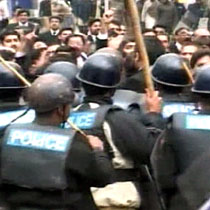
Pakistani President Pervez Musharraf's suspension of the nation's chief justice has sparked several months of street protests in Pakistan. The outcry against General Musharraf is the strongest public challenge to his presidency1 since he took power in a bloodless coup2 eight years ago. It also comes as Pakistan prepares for legislative3 elections. As VOA's Robert Raffaele explains, the future of Musharraf's regime is now in question.
 |
| Pakistani protests |
The suspension has fueled months of street protests, with lawyers and opposition5 activists6 who oppose General Musharraf demanding his resignation.
The government has responded by cracking down on lawyers, opposition parties and the media.
During a recent forum about Pakistan's future (Monday, June 18th) in Washington at the Carnegie Endowment for International Peace, several speakers said General Musharraf must begin accommodating opposing voices to prevent further chaos7.
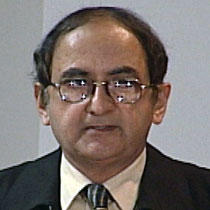 |
| Professor Hasan Askari Rizv |
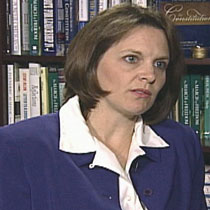 |
| Lisa Curtis |
The United States has praised General Musharraf repeatedly, calling him an ally in the war on terror. U.S. Deputy Secretary of State John Negroponte met with the Pakistani president and Prime Minister Shaukat Aziz last week. Negroponte offered them U.S. support, but he also urged them to ensure that forthcoming elections are free and fair.
Professor Rizvi says many Pakistanis resent Washington’s unwavering support of General Musharraf. "The U.S. government has to acknowledge -- in its support of the [Pakistani] government -- that there are serious concerns expressed in Pakistan's political circles and the government of Pakistan needs to address those concerns."
Lisa Curtis agrees that the U.S. must privately11 press General Musharraf to work toward bringing civilian democratic rule to Pakistan. She says if he refuses to do so, prolonged unrest may force his army to insist that he step down, and result in a new leader who is not friendly toward Washington.
She says General Musharraf can still determine whether Pakistan moves closer toward democracy, or more violence. "If Musharraf develops an approach where he takes all the parties into (his) confidence, he acknowledges the changing scenario12 that is happening, and the increased demands for a return to democratic civilian rule. If he can somehow spearhead that effort, that transition to democracy, then I think we are looking at a much more peaceful, more predictable transition, and you would be more likely to see a leader who is democratic, more secular13 in his outlook, and has the same pro-U.S. views that Musharraf does."
General Musharraf, however, appears unwilling14 to give up his presidency without a struggle. Under Pakistan's constitution, parliament elects the president.
General Musharraf has drawn15 criticism for suggesting he would seek re-election from the current parliament, which endorsed16 him in 2002.
 收听单词发音


