2007年VOA标准英语-Tony Blair Steps Down With Mixed Legacy After 1
搜索关注在线英语听力室公众号:tingroom,领取免费英语资料大礼包。
(单词翻译)
By Sonja PaceLondon
22 June 2007
British Prime Minister Tony Blair steps down June 27th after a decade in power during which he re-energized his Labor1 Party, embarked2 on an interventionist foreign policy and forged ever-closer ties with the United States. But, as Mr. Blair hands over the reins4 of power one damaging decision follows him out of office, his unfailing support for the war in Iraq. VOA's Sonja Pace takes a look at the Blair legacy5 in this report from London.
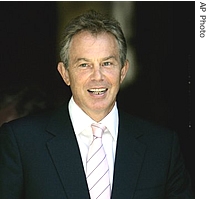 |
| Tony Blair (File) |
After a sweeping6 election victory in 1997, Tony Blair promised a new direction.
"You, the British people have given us the chance to serve you," said Mr. Blair. "You have put your trust in us and we say to you - we shall repay that trust for you. We govern for you."
He promised to revitalize the country with a dynamic, efficient approach more in tune7 with the new global economy. He vowed8 more effective social programs and brought a new, relaxed style to Number 10 Downing Street.
But, it wasn't just style and an ability to connect with average people that made Tony Blair popular. Blair biographer Anthony Seldon says it was also plain political skill.
"He won more elections than any other Labor prime minister, he changed the face of the Labor Party, he produced peace in Northern Ireland after many years of fighting," he noted9.
The Northern Ireland peace process of 1998 came to fruition less than two months ago with the formation of a unity10 Catholic-Protestant government for the province. Mr. Blair was in Belfast to clinch11 the deal.
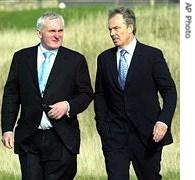 |
| Britain's Prime Minister Tony Blair (r) and Ireland's Prime Minister Bertie Ahern |
Dealing12 with conflicts near and abroad became a cornerstone of Mr. Blair's interventionist foreign policy. In 1999 - he argued forcefully for the international community to intervene in Kosovo. And, Britain's military intervention3 in the West African nation of Sierra Leone in 2000 is credited with helping13 bring to an end a brutal14 civil war there.
Mr. Blair won a landslide15 second term in office in 2001, but then the world changed on September 11.
"The full horror of what has happened in the United States earlier today is now becoming clearer," he said. "It is hard even to contemplate16 the utter carnage and terror which has engulfed17 so many innocent people."
Mr. Blair stood with U.S. President George Bush, forging ever-closer ties between London and Washington. He was instrumental in making the case for action against al-Qaida in Afghanistan and went along willingly into Iraq.
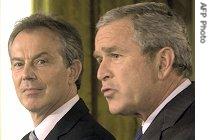 |
| George Bush, Tony Blair at White House press conference, July 28, 2006 |
While Mr. Blair is widely credited with having tempered the Bush administration's go-it-alone approach in the early preparations for Iraq, he has been harshly criticized for not being able to influence how the war and the aftermath were handled.
Michael Brown, former conservative member of parliament and now political columnist18 for the Independent newspaper, tells VOA, Iraq was Tony Blair's biggest mistake.
"His enduring legacy, in terms of British public life, will, I'm afraid be Iraq," he noted. "Iraq will be engraved19 on Tony Blair's political tombstone when the history books of his premiership are written."
Iraq took its toll20 on Mr. Blair's popularity and still - he won a third term in office in 2005, even though the Labor party took a beating. Then in July terrorist attacks on London's transport system claimed the lives of 52 commuters.
Speculation21 was rife22 that Tony Blair would not last to the next election scheduled for 2010. That speculation proved correct.
"Today, I announce my decision to step down from the leadership of the Labor Party," he said. "Hand on heart, I did what I thought was right. I may have been wrong, but believe one thing if nothing else, I did what I thought was right for our country."
It is too early to tell how Tony Blair will eventually be remembered, but for now Iraq casts a long shadow over his legacy.
 收听单词发音


