2007年VOA标准英语-US Could Begin Withdrawal if Iraqis Can Take Ov
搜索关注在线英语听力室公众号:tingroom,领取免费英语资料大礼包。
(单词翻译)
By Al PessinPentagon
22 June 2007
The second-ranking U.S. commander in Iraq says the week-old offensive against insurgent1 groups in and around Baghdad could create conditions for the start of a U.S. withdrawal2 sometime between this fall and next spring. Lieutenant3 General Ray Odierno spoke4 from Iraq to reporters at the Pentagon, and VOA's Al Pessin reports.
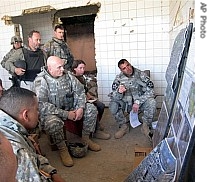 |
| Lieutenant General Raymond Odierno, center, is briefed by a field commander at a bombed-out hospital in Baqouba, Iraq, 21 June 2007 |
"We are beyond a surge of forces, and we are now into a surge of operations," he said.
The general says the offensive called "Phantom6 Thunder" involves several large simultaneous operations in and around Baghdad, as well as smaller moves by special operations forces targeting al-Qaida's supply lines for weapons and explosives.
"We have already begun attacking the enemy from multiple directions in ways that I believe he will not be able to resist," he added. "Our pursuit will be agile7 and relentless8. Our goal is to force the enemy to fight from positions of disadvantage, while we maintain the initiative."
General Odierno says there have been some encouraging results from the first week of the operation, including the killing9 of more than 150 insurgent fighters, the arrest of more than 700 insurgents, including 50 leaders, and the discovery of more than 300 bombs and 128 weapons caches. But he says there is still much work to do, and the operation will continue through the summer.
That would take it to about the time he and other senior U.S. officers and diplomats10 are to issue a report assessing the impact of the troop surge. The general says the key element will be the ability of the Iraqi army and police to maintain security, once areas are cleared of insurgents, something that has not been done after previous offensives.
"With the amount of forces that we now have, we will be able to stay in these areas where, in fact, we've had either no or very little capability11 to do this previously," he explained. "So the Iraqi security forces will be able to sustain and continue to improve their ability to maintain security."
Senior U.S. officials have said they hope the offensive will create the conditions for the start of a withdrawal of 155,000 U.S. troops in Iraq by the fall. General Odierno said that might be possible, but he might need the higher troops level somewhat longer than that.
"When are they going to have enough forces, enough leaders, to sustain this over time?" he asked. "It could be this fall because we continue to build and they continue to improve. It might take a little bit longer than that. It might be until the spring. I don't know. But that's what we have to continue to work with them."
General Odierno also discussed the controversial move by some of his forces to forge alliances with insurgent groups, militias12 and tribes that want to switch to the coalition13 side of the conflict.
"We have not given weapons to any insurgent groups," he noted14. "They have plenty of weapons. The point about reconciliation15 is I want those weapons to be used against al-Qaida, and not against coalition forces or Iraqi security forces. These groups are reaching out to us and we are reaching back. They want to fight al-Qaida and we think they can help us."
The general says the insurgent groups that want to cooperate with U.S. and Iraq forces must demonstrate their commitment by providing information or taking on other tasks. He says one such group led U.S. forces to 16 large buried bombs, while information from another group doubled the number of bombs found in its area.
General Odierno also provided an update on Iran's role in the Iraq violence.
"I think they are trying to surge their support to Shia' extremists," he said. "We've seen an increased flow of training to mortar16 teams and rocket teams. We've seen an increase in some flow of weapons and munitions17 into Iraq."
General Odierno says Iran surged its support for Iraqi Shi'ite groups at the same time that the United States was surging its additional troops to Iraq. He says Iran's elite18 Quds Force is using a supply network that dates back to the Saddam Hussein era, and that one goal of the current operation north of Baghdad is to disrupt that network. He says Iran is also helping19 some small Sunni groups in order to further destabilize Iraq, but he says that effort does not seem to have increased since he first reported it in April.


