2007年VOA标准英语-UN Closes Iraq Weapons Inspection Unit
搜索关注在线英语听力室公众号:tingroom,领取免费英语资料大礼包。
(单词翻译)
By Peter HeinleinUnited Nations
29 June 2007
The U.N. Security Council has closed down the agency charged with monitoring Saddam Hussein's illicit1 weapons programs. Correspondent Peter Heinlein reports from U.N. headquarters in New York.
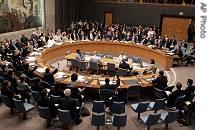 |
| U.N. Security Council |
Russia's U.N. ambassador, Vitaly Churkin, objected that the inspectors4 had not fulfilled their mandate5 of officially certifying6 that Iraq, at present, has no weapons of mass destruction. But he said Russia is willing to accepts that UNMOVIC serves no further purpose.
"The fact that this issue has been with us for a very long time and some of those requirements have been taken into account did allow us not to block this resolution, but in a situation where some of the requirements have not been taken care of, we decided7 to abstain," he said.
Iraq's U.N. ambassador, Hamid Al-Bayati, hailed the decision to terminate UNMOVIC. He said it closes what he called "an appalling8 chapter in Iraq's modern history."
"We believe this is an overdue9 issue pending10 for over four years and this chapter has been closed today, which was costing Iraq around one million dollars every month," he said.
UNMOVIC was established in 1999 to oversee11 the dismantling12 of Saddam Hussein's weapons of mass destruction programs. The inspectors left Iraq in March 2003, shortly before the U.S.-led invasion that toppled Saddam. They never returned, and have since been focusing on studying satellite photographs.
The U.N. inspectors did find significant evidence of Saddam's illicit weapons programs, including biological and chemical agents. The U.N. nuclear watchdog agency, the IAEA, also assisted in uncovering details of a planned nuclear weapons program.
But Washington's U.N. ambassador, Zalmay Khalilzad, told the Security Council Friday that concerns about Saddam's possession of nuclear weapons in 2002 and 2003 had proven to be unfounded.
"With regard to nuclear weapons, the Iraq Survey Group uncovered evidence of the maturity13 and intent of the pre-1991 Iraqi nuclear program," he said. "The government determined14, however, that the Iraqi ability to reconstitute a nuclear weapons program had progressively deteriorated15 after 1991 despite Saddam Hussein's interest in nuclear weapons and in retaining nuclear weapons scientists."
Speaking to reporters afterward16, Khalilzad said intelligence about Saddam's weapons programs had proven wrong both at the time of the first Gulf17 war, when it was underestimated, and again in 2003, when it was overestimated18.
"We've all learned lessons," he said. "In hindsight, one would have hoped to have had in both cases a more precise information, but you make decisions based on what you assume or analyze19 or are briefed or are told is the situation to the best of one's ability."
The United States and Iraq had been trying to have UNMOVIC shut down since 2005. Iraq's leaders had complained that financing UNMOVIC had been draining money from the Iraqi budget that would better have been used in rebuilding infrastructure20 in the war-ravaged country.
 收听单词发音


