生活英语对话 Episode 57: Dr Laver takes the plunge
搜索关注在线英语听力室公众号:tingroom,领取免费英语资料大礼包。
(单词翻译)
本单元是关于医生冒然行动的对话
Dr. Laver: I had a lovely time at the barbecue, although I drank too much wine. I had a terrible hangover.
Alice: Did you? I just wish I hadn't had that salmon1, especially as I'd already had enough food. I was just being greedy.
Dr. Laver: Oh well, not to worry, you'll be alright soon. In fact, I was wondering, erm...
Alice: Yes, yes?
Dr. Laver: Well, when you're well enough, would you like to go out one evening?
Alice: Are you asking me out on a date, Dr. Laver?
Dr. Laver: Well yes, I... I guess I am, and please, call me Paul.
Alice: Well, Paul, I'd love to go on a date.
Dr. Laver: Great. Would Friday be too soon?
Vocabulary (词汇):
to take the plunge2 (idiom) 冒险尝试;毅然从事(习语):
decide to do something important, difficult or risky3
a hangover (宿醉,即因饮酒过度引起的头痛、恶心等):
this is when you feel ill because you have drunk a lot of alcohol
greedy (贪心的,贪婪的):
you take or eat more than you need
a date (约会):
this is when you go out for a romantic evening with someone
本单元的语言点是关于 Too 和 enough 的用法, 请看下面的解释和例句
Too and enough
Basic definition (基本定义):
We use too and enough to talk about the quantity or size of something. Too indicates that there is a problem with the quantity or size of something. Enough indicates that the quantity or size of something is suitable or appropriate.
The shoe is too big = it does not fit my foot properly; it is the wrong size
The shoe is big enough = it fits my foot properly; it is the correct size
Not enough means that there is a problem with the quantity or size of something. The quantity is insufficient4.
The shoe is not big enough = The shoe is too small
Used with adjectives (与形容词一起使用):
We put too before the adjective and we put enough after the adjective.

Used with nouns (与名词一起使用):
We put enough before nouns.
We use too much/ too little before uncountable nouns.
We use too many/too few before countable5 nouns. 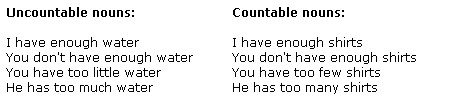
Used with adverbs (与副词一起使用):
We put too before the adverb and we put enough after the adverb.
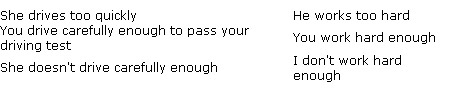
Used with verbs (与动词一起使用):
With some verbs, we can use too much and enough like adverbs. We rarely use too little in this way, although it is possible.

 收听单词发音


