2007年VOA标准英语-Radio Station Provides Vital Link for People on
搜索关注在线英语听力室公众号:tingroom,领取免费英语资料大礼包。
(单词翻译)
By Greg FlakusPorcupine1, South Dakota
28 August 2007
There are many ethnic2 radio stations and broadcast programs in the United States, but there is only one fully3 independent community radio station serving the residents of a Native American Indian reservation. That is KILI radio on the Pine Ridge4 reservation in southwestern South Dakota. It operates from the top of a butte near the village of Porcupine and broadcasts in both English and the native Lakota language. VOA's Greg Flakus went there and filed this report on "the Voice of the Lakota nation."
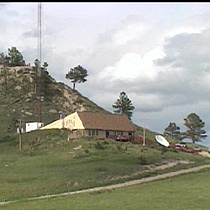 |
| Radio station KILI serves the Lakota community in the Pine Ridge reservation |
Some people here are involved in ranching5, but this is one of the poorest places in the United States, with unemployment at around 70 percent and an average annual family income of just $3800.
For the Lakota people who live here and in the nearby Black Hills and Rapid City, KILI radio is a beacon6 of hope as well as a way of keeping in touch with the community at large.
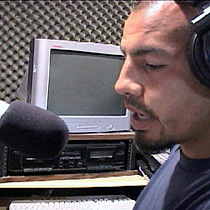 |
| Derek Janis, a volunteer, on the air |
KILI roughly translates to "cool" or "awesome8" in English. The station provides news about activities and events on the reservation, as well as music -- ranging from country to hip9 hop7, with lots of native traditional singing as well.
Local college professors and students come in every week to discuss Lakota myths and stories. The station also does live broadcasts of tribal10 council meetings.
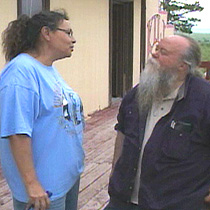 |
| Melanie Janis and Business Manager Tom Casey on the station's porch |
One of the longest-serving members of the KILI Radio staff is Business Manager and Development Director Tom Casey. "The station has a way to connect people, keep people connected, information-wise, issue-wise, culture-wise, things that are happening in the community, things that are going on. It just connects people," says Casey.
Part of each day's broadcast is done in the Lakota language, which is still widely spoken by older people and is being taught to school children. The language was in danger of dying because of government efforts to force American Indians to speak English in decades past.
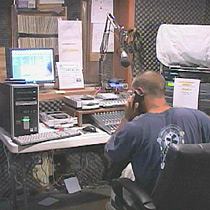 |
| Derek Janis in the station's main control room |
That power is not lost on younger volunteer broadcasters, like Melanie Janis' 25-year-old son Derek. He is trying to learn more Lakota. "You hardly see young guys my age talking fluently. Everybody has slang words they mix in with the English, so it kind of gets broke up. I am working on it. I am trying to learn myself."
KILI radio is supported by donations as well as grants from charitable groups, and can be heard around the world on the Internet at www.kiliradio.org
 收听单词发音


