2007年VOA标准英语-Uzbekistan's Strict Border Regime Separates Uzb
搜索关注在线英语听力室公众号:tingroom,领取免费英语资料大礼包。
(单词翻译)
By Peter FedynskyKara Suu, Kyrgyzstan
29 August 2007
When the vast lands of the former Soviet1 Union comprised a single nation, borders between constituent2 republics did not significantly hinder trade and travel among them. But after the Soviet collapse3 in 1991, those republics -- now independent nations -- instituted border controls, some lenient4, some strict. One of the strictest separates the Central Asian country of Uzbekistan from Kyrgyzstan. VOA Moscow correspondent Peter Fedynsky recently visited that frontier, and learned that it also separates Uzbeks from Uzbeks.
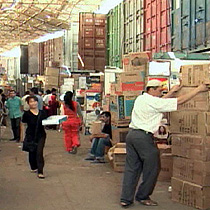 |
| The Kara Suu market, Kyrgyzstan |
The Kara Suu market offers a myriad7 of imported goods. Signs on local Internet cafes indicate some of the countries that the people here do business with. They include China, Russia, Turkey, South Korea and Pakistan.
However, Uzbekistan -- within walking distance of the market -- is no longer a significant economic factor here.
In 2003, Uzbek President Islam Karimov's government dismantled8 a bridge that crossed the Shakhrikhan-Say River between the Kyrgyz and Uzbek sides of Kara Suu. The move was part of Uzbekistan's protectionist trade policy aimed at limiting imports. The move not only hurt commerce on the Uzbek side of the border, but it has also impacted ethnic Uzbeks in Kyrgyzstan who buy and sell imported goods in Kara Suu.
A local merchant, Odina, says she has noticed a drop in her sales of DVD players. "We don't understand the problem. We are ordinary entrepreneurs. Our business depends on people from Uzbekistan. If there are no customers from Uzbekistan, there is no trade."
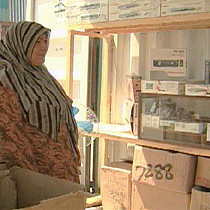 |
| Odina sells electronics and other goods |
Alisher Saipov is an independent journalist in the southern Kyrgyz city of Osh and a freelance correspondent with VOA's Uzbek Service. He says authorities in Uzbekistan have been unable to cut off the cross-border flow of ideas.
"Freedom does not seem to recognize borders. Uzbek authorities try to control the border with the help of their Kyrgyz and Tajik colleagues,” he says. “Nonetheless, ideas here spread. I would say various ideas, including extremist ideas, democratic ideas, and also radical10 ideas."
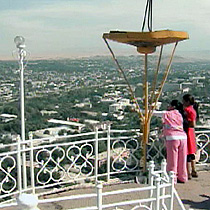 |
| An observation deck overlooking Kara Suu and to Uzbekistan beyond the river |
The director of the UNHCR office in Osh, Mulusew Mamo, says the Karimov regime falsely accuses political opponents of various crimes. "Some of them might be involved in politics; some of them might be involved in human rights issues, which is the right of an individual to raise issues of human rights. But that's normally interpreted by the government, I guess, as 'anti-government'."
Mamo says about 70 Andijan refugees remain in Osh. And local activists15 say people continue to come in search of freedom.
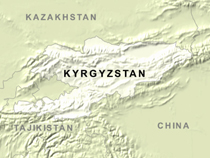 |
| Kyrgyzstan, with Uzbekistan to the west |
While the Uzbek government severely16 restricts ties among Uzbeks, it has not stopped them. People on both sides of the frontier find ways to continue what they say are ethnic bonds that predate any borders between them.
 收听单词发音


