2007年VOA标准英语-Land Issues Pit Saharan Nomads Against Governme
搜索关注在线英语听力室公众号:tingroom,领取免费英语资料大礼包。
(单词翻译)
By Phuong TranN'Djamena, Chad
29 August 2007
Decades of drought in the Sahel desert and its vast mineral reserves, have forced nomads2 to defend their pastures from both farmers and foreign investors3. Land disputes have erupted into violent conflicts in parts of the Sahel, stretching from Senegal to Sudan, in recent years. This month, violence has escalated4 in Niger and Mali, involving nomad Tuareg fighters. As nomads are drawn5 into violence, analysts6 say it will become even harder for governments to end nomads' isolation7 and marginalization. Phuong Tran files from N'Djamena, Chad.
nomad1 children,Messaouda and Lala Fatma in Marseique village " hspace="2" src="http://www.tingroom.com/upimg/allimg/070901/1403350.jpg" width="210" vspace="2" border="0" />
Mauritanian nomad children, Messaouda and Lala Fatma in Marseique village
Chad's roaming communities, like this one in Mani Kossam, do not show up in population counts. Governments have a hard time tracking clusters of families who periodically move their herds8 from one rain-fed pasture to the next.
Officials estimate there are about 450,000 nomads and semi-nomads in Chad, roughly five percent of the population.
They say the people of this group are among the country's poorest and least educated, because they typically live in remote areas with little access to health care or schools.
Yousseuf Abdel Kerim, himself a child of Arab nomads, oversees9 a renewed government effort to enroll10 children from nomadic11 families into one of 60 stationary12 schools recently set up, around the country, for them.
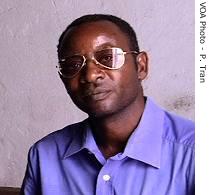 |
| Yousseuf Abdel Kerim, Nomad Education Coordinator13, Chad Ministry14 of Education |
Kerim says the new strategy is to ask families to leave half their children behind, during seasonal migrations17, so the children can attend school.
More than 10,000 children have enrolled18, about two percent of the estimated nomadic population.
Senegalese sociologist19 Djiby Diakhate says, despite efforts to integrate nomads with the rest of the population, there is still a long way to go.
He says there is a historical conflict between nomads and non-nomads. The sociologist says many people persecute20 nomads as savage21 outsiders.
Diakhate says this tension can erupt when there are land disputes.
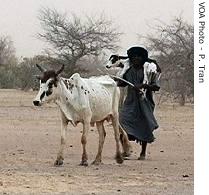 |
| Nomad man with a cow |
In 2003, the tension exploded in Darfur into interethnic violence. The United Nations says fighting has displaced more than two million people, left hundreds of thousands dead and spread into neighboring Chad and Central African Republic.
British anthropologist22 and Saharan expert Jeremy Keenan says a shortage of fertile land is also a problem for Tuareg nomads in Niger and Mali.
In the 1990's, they took up arms against their governments, demanding more autonomy and complaining that foreign companies were taking their land to mine uranium.
Earlier this year, some Niger Tuaregs re-launched attacks, saying their government has failed to honor its promises from a 1995 peace deal, which included sharing more uranium wealth.
Niger government officials say most Tuareg demands from the 1990's have been met.
However, anthropologist Keenan says the Niger government is still overlooking how important land in northeast Niger, home to uranium mines, is to nomads.
"You have got possibly one of the most important pastoral zones in the entire Sahelian belt which traditionally has been an area highly valued by many different nomads, not just Tuaregs," said Kenaan.
Niger Tuareg leaders have vowed23 continued violence until the government stops dismissing them as "drug smugglers" and "bandits," and starts recognizing their demands as legitimate24.
Defense25 officials in Mali have accused Mali-based Tuareg nomads of kidnapping almost 40 government soldiers this week, a tactic26 also used by Niger's nomad tribes in their seven-month uprising.
No one has claimed responsibility for the kidnappings.
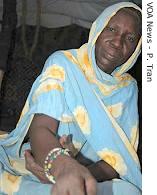 |
| Moulkhere |
Far from Tuareg territory disputes is Marseique, a Mauritanian desert village.
In this eastern part of the country, near the Malian border, about 70 percent of the population is made up of non-Arab nomads.
Moulkhere, a mother of four, sits on a stone seat by the fire to prepare her family's evening meal.
She says she used to live in the city, but moved her family back to the desert because she prefers the silence and solitude27 of desert life.
Here, she can raise her girls like she wants.
Moulhkhere says no one bothers them, out here.
 收听单词发音


