2007年VOA标准英语-Iraq Government Calls on All Militias to Freeze
搜索关注在线英语听力室公众号:tingroom,领取免费英语资料大礼包。
(单词翻译)
By Sonja PaceCairo
31 August 2007
The Iraqi government called on armed groups in the country to freeze activities after more than 50 people were killed and hundreds injured in fighting between rival Shi'ite groups in the holy city of Karbala earlier this week. VOA's Sonja Pace reports from our Middle East bureau in Cairo.
| Shi'ite cleric Moqtada al-Sadr speaks to supporters at Friday prayers at his local mosque in Kufa, central Iraq, 25 May 2007 |
Friday prayers in Karbala took place amid an uneasy calm, just days after clashes between rival Shi'ite groups killed dozens, injured hundreds and sent hundreds of thousands of pilgrims fleeing the holy city.
Two of Shi'ite Islam's holiest sites turned into a battlefield early in the week as police, predominantly affiliated2 with the Supreme3 Islamic Council of Iraq fought against gunmen linked to radical4 cleric Moqtada al Sadr.
Prime Minister Nouri al-Maliki, also a Shi'ite, traveled to Karbala and vowed5 to restore order. And, Moqtada al Sadr later announced his militia6 would halt its activities for up to six months.
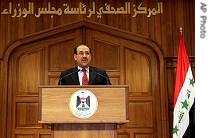 |
| Iraqi PM Nouri al-Maliki delivers a speech during an opening ceremony for the Government Media Center in Baghdad, 26 Aug 2007 |
Some Iraqi officials are downplaying the significance of the clashes in Karbala. But, Middle East analyst8, Joost Hiltermann from the International Crisis Group, describes the violence as primarily a class conflict, a long time in the making.
"It is a fight between the Shi'ite underclass, the jobless, the followers9 of Moqtada al Sadr and the middle class, represented by the Supreme Council as a political party, by Ayatollah Sistani as the senior Shi'ite cleric and the merchant class that lives in the holy cities," he said.
As such, Hiltermann says these inter-Shi'ite clashes are a fight for supremacy10, what he describes as a social revolution and yet one more conflict in Iraq's layers of civil wars.
 收听单词发音


