VOA标准英语2008年-Bowing to Protests, S. Korea Imposes New Condit
搜索关注在线英语听力室公众号:tingroom,领取免费英语资料大礼包。
(单词翻译)
By Kurt Achin
Seoul
03 June 2008
South Korea is seeking to ease some domestic irritation1, with a move that could complicate2 American-Korean trade relations. Seoul is amending3 its promise to resume U.S. beef imports by imposing4 new trade conditions aimed at placating5 political critics of the South Korean president. VOA Seoul Correspondent Kurt Achin reports.
In what he described as a "humble6 acceptance of the people's will," South Korean Agriculture Minister Chung Woon-chun announced a new set of limitations on plans to import U.S. beef.
He says South Korea has requested the American government stop exporting cattle aged7 30 months or older, about which South Korean consumers have expressed the most anxiety. He says his ministry8 will postpone9 scheduled quarantine inspections10 of American beef until the United States responds to the request.
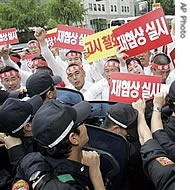 |
| South Korean members of Jellanamdo Provincial11 Assembly are blocked by riot police officers as they try to march to the Presidential House in Seoul, South Korea, 03 June 2008 |
The move is a reaction to street protests which began weeks ago, opposing American beef imports. The demonstrations12 have evolved into much broader, grassroots criticism of South Korean President Lee Myung-bak's leadership style.
Two months after his February inauguration13, Mr. Lee arranged a deal to fully14 resume imports of virtually all cuts of U.S. beef. The imports were banned in 2003, after an American animal was found to have the fatal brain condition known as "mad cow disease." It is theoretically possible for humans to contract a version of the disease by eating tainted15 meat.
Mr. Lee's import resumption deal, clinched16 during an April summit with President Bush, fulfilled a promise made more than a year earlier by Mr. Lee's predecessor17. It also followed a ruling by a United Nations organization, backing Washington's assertion that U.S. beef is safe.
Nonetheless, many South Koreans saw President Lee's decision to resume the imports as too sudden, too wide-ranging - and too dismissive of public sentiment.
Protests that began as quiet candlelight vigils, last month, have gradually grown louder and more violent. Tens of thousands of protesters have gathered almost nightly in downtown Seoul, blocking major traffic arteries18 and leading to hundreds of arrests.
Although protesters are unable to cite a single confirmed case of a human contracting brain disease from consuming U.S. beef, their gatherings19 have served as a magnet for groups with a host of grievances20 against the South Korean president.
American officials have repeatedly refused to re-negotiate U.S. beef imports and are unlikely to agree to Seoul's new beef import conditions. Analysts21 warn the escalating22 beef dispute could endanger ratification23 of the major trade deal the two countries, signed last year.
 收听单词发音


