VOA标准英语2008年-US Supreme Court: Terror Detainees Can Appeal t
搜索关注在线英语听力室公众号:tingroom,领取免费英语资料大礼包。
(单词翻译)
By Al Pessin
Washington
12 June 2008
The U.S. Supreme1 Court has ruled that terror suspects at the Guantanamo Bay detention2 center have the right to challenge their detention in U.S. civilian3 courts. President Bush says he will try to work with Congress to find a way around the ruling. VOA's Al Pessin reports from the Pentagon.
The Supreme Court ruled in a 5-4 vote that at least part of the revised process for holding and trying Guantanamo detainees, passed by the congress two years ago, is invalid4. Specifically, the court said the detainees have what is called the right of habeas corpus, the right to challenge their detentions5 in regular U.S. federal courts.
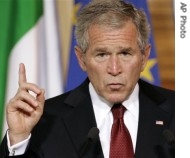 |
| US President George W. Bush answers journalists' questions at Rome's Villa6 Madama, 12 Jun 2008 |
Speaking during a visit to Italy, President Bush said he will abide7 by the decision, but does not agree with it. He said he agrees with the court's minority, which defined the fight against terrorism as a "war."
"We'll study this opinion," he said. "And we'll do so with this in mind, to determine whether or not additional legislation might be appropriate so that we can safely say, and truly say, to the American people, 'We're doing everything we can to protect you.'"
But that may be more difficult than it was the two previous times the Supreme Court struck down parts of the government's special process for dealing8 with Guantanamo detainees. President Bush is now well into the last year of his term, and his political influence is waning9. In addition, the Congress is now controlled by his political opponents in the Democratic Party.
And Joanne Mariner10, who handles terrorism issues in the New York office of Human Rights Watch, says this time the Supreme Court has ruled that the detainees' right to appeal is rooted in the constitution, not ordinary laws.
"This is a constitutional ruling," she said. "This time it ruled explicitly11 that it's the U.S. Constitution that undergirds its ruling. So it will not be possible for Congress to affect that aspect of the ruling."
Writing for the court majority, Justice Anthony Kennedy wrote "The laws and Constitution are designed to survive, and remain in force, in extraordinary times." But he wrote federal judges could still decide to keep a detainee in custody12 if there are legitimate13 security concerns.
Defense14 Secretary Robert Gates says his department is studying the ruling's implications, but declined further comment for now.
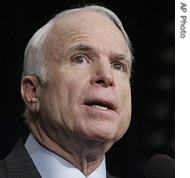 |
| John McCain, 10 June 2008 |
Republican presidential candidate Senator John McCain said he is concerned about the ruling.
"These are unlawful combatants," he said. "They are not American citizens. But it is a decision the Supreme Court has made. Now we need to move forward."
One of the Senate's leading Democrats15, the Chairman of the Judiciary Committee, Patrick Leahy, said his view of the Bush administration's detainee policy has been vindicated16.
"Today's Supreme Court decision is a stinging rebuke17 of the Bush administration's flawed detention policies," he said. "It's a vindication18 for those of us who argued from the beginning that it was unwise as well as unconstitutional."
Joanne Mariner at Human Rights Watch calls the ruling "a landmark19" that restores U.S. credibility, and "a first step toward creating a fair process for the detainees," who were picked up as part of the global war on terrorism
Several cases are already pending20 in federal courts, where judges have been awaiting the Supreme Court ruling.
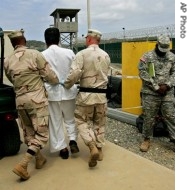 |
| A detainee, center, is escorted by US military personnel at the detention facility at Guantanamo Bay US Naval21 Base (file photo) |
Some of the cases involve alleged22 torture. And in some cases the government has admitted using harsh interrogation techniques. Mariner says that will be part of the information federal judges will now consider. But she says it does not necessarily mean all 275 men held at Guantanamo will be released. She says that will be up to the federal judges assigned to each individual case.
"Many of the September 11th suspects have confessed to being what the government argues that they are -- perpetrators of terrorist attacks," said Mariner. "Those people are not going to be released because there is actual good reason to hold them."
But Mariner says this will allow U.S. civilian federal courts, with independent judges, to review the evidence in each case, and hear arguments from the government and the detainees' lawyers, and then decide whether each man should be held.
Mariner says this could also be the beginning of the end of the military commissions process, which the 2006 law established to hold trials for the detainees, but she says that depends on future rulings. Already, the Associated Press quotes the military lawyer for one detainee, Salim Hamdan, who was to go on trial next month, as saying he will call for the case to be dismissed based on Thursday's Supreme Court ruling.
 收听单词发音


