VOA标准英语2008年-US Space Agency Plans Solar Probe
搜索关注在线英语听力室公众号:tingroom,领取免费英语资料大礼包。
(单词翻译)
By Michael Bowman
Washington
12 June 2008
The U.S. space agency is planning to send a probe to the sun to gather data and shed light on basic questions about how the star operates and its effects on Earth. VOA's Michael Bowman reports from Washington, the initiative entails1 numerous technological2 challenges that will test the skill and ingenuity3 of engineers assigned to the project.
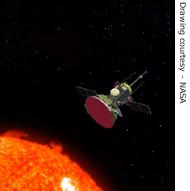 |
| Artist's drawing of the Solar Probe spacecraft |
It is the brightest, most prominent feature of our sky, yet in many ways the sun is shrouded4 in mystery.
"We have never had a voyage to a star. We do not know what it does up close, next to its visible surface. And we do not know the [sun's] physical processes very well," said Richard Fisher, who heads NASA's Heliophysics Division, the body responsible for studying the sun.
Among the questions that have long-stumped researchers: how can it be that the sun's outer atmosphere, the corona5, is hundreds of times hotter than the star's surface? What force is responsible for solar winds - the stream of charged particles contributing to geo-magnetic storms that affect electrical and communications systems on earth - given that no organized wind has been detected at the sun's surface?
To get some answers, NASA hopes to launch a probe weighing about half a ton into the sun's atmosphere to measure the magnetic field, sense plasma6 waves, and analyze7 particles emitted from the star. A telescopic imager will take three-dimensional pictures of the corona.
"We are going to go close to a star. It is going to be very hot. There is a technological issue of how you generate power; there is a lot of sunlight, but you cannot use all of it. There is a technical problem of how you shield the payload from all the radiance. And then you have to transmit data halfway8 across the solar system, almost," Fisher said.
Planners envision a carbon-composite heat shield that will have to withstand temperatures in excess of 1,400 degrees Celsius9 and survive massive radiation blasts. As one might expect, the craft will be solar-powered with retractable10 liquid-cooled solar panels.
NASA chose the Johns Hopkins University's Applied11 Physics Lab to design and build the probe.
Project Manager Andrew Dantzler says he relishes12 the unprecedented13 engineering challenges facing his team.
"It really is a convolution of technologies that have advanced over the last several years: high-temperature materials, more-efficient solar arrays. It is technology like that that have made this [project] possible," he said.
Dantzler says, when the probe is launched, perhaps as early as 2015, it will constitute the fulfillment of a goal that astronomers14 and other scientists set forth15 decades ago.
"This idea goes all the way back to the beginning of the space age. In 1958, the National Research Council first introduced the concept of sending a probe close to the sun. But it is only recently that we have come up with the optimal16 way of doing that kind of mission."
NASA says, for now, the solar probe mission is an entirely17 U.S. endeavor, but that space agencies of other nations have expressed an interest in the project and that collaboration18 would be welcomed.
NASA says, not only will the probe generate information that could prove valuable in predicting solar storms that interrupt electrical systems on Earth, the craft could potentially serve as an early-warning system for solar activity that might affect future human space travel.
 收听单词发音


