VOA标准英语10月-UN Expert Warns Use of Torture Widespread in Many
搜索关注在线英语听力室公众号:tingroom,领取免费英语资料大礼包。
(单词翻译)
The independent U.N. expert on torture and other cruel, inhuman1 or degrading treatment, says torture is practiced frequently in many countries, and that prison conditions are often so poor they can be considered cruel and inhuman treatment. From United Nation's headquarters in New York, VOA's Margaret Besheer has more.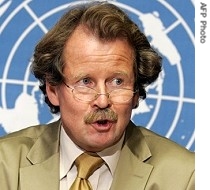 |
| Manfred Nowak (file photo) |
Special Rapporteur Manfred Nowak said that while many individual countries have improved the treatment of detainees and prisoners over the years, torture and ill treatment continue to be widespread.
"On a global level I still come to the conclusion on the basis of many fact-finding missions and other evidence, that torture and ill-treatment is still practiced on a widespread, partly even systematic2 and routine level, in many countries of the world," he said.
He said the conditions of detention3 are appalling4 in many countries, with prisoners living in overcrowded jails, lacking access to food, healthcare, fresh air and hygiene5.
"Prisoners and detainees are among most vulnerable groups in every society," he said. "And we have about nine to 10 million people detained on a global level, and I would say that many of them - millions of individuals - are living in appalling conditions that could only be described as cruel, inhuman or degrading treatment."
Nowak also criticized the practice of solitary6 confinement7, saying it is often used for prolonged periods of time and to coerce8 confessions9 from suspects.
"We have enough medical and psychiatric evidence that isolation10, complete isolation, even often after very few weeks already, may lead to serious mental problems and mental illnesses, and that is why I am calling upon governments, in general, to review their policies and apply solitary confinement only if it is absolutely necessary to achieve a legitimate11 purpose and for as short a period as possible," he said.
In a recent report to the U.N. General Assembly, the Special Rapporteur criticized several countries for their solitary confinement practices, including the United States for its practices at its Guantanamo Bay facility; Mongolia, which often keeps inmates12 in solitary confinement for the entire length of their multi-year sentences; and China, where female prisoners have been held in isolation to receive the so-called "training" to renounce13 their beliefs.
Nowak also warned that persons with mental and physical disabilities are particularly vulnerable to ill treatment --including neglect and isolation, physical, mental and sexual abuse. He said disabled persons in institutions or detention facilities are often subjected to medical experiments or treatments such as forced abortions14, sterilization15 and electroshock treatment without their consent. The Special Rapporteur called on countries to step up monitoring of institutions where these people are held to prevent such abuses.


