voa标准英语2008年-South Korean Officials Return From North As Joi
搜索关注在线英语听力室公众号:tingroom,领取免费英语资料大礼包。
(单词翻译)
South Korean officials who usually work in North Korea have returned home as ties between the two cold war rivals worsen. Both sides are getting ready for a complete border closure the North has promised to enforce next week. VOA's Kurt Achin has more from Seoul.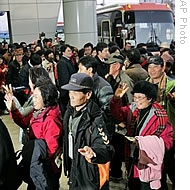 |
| South Korean tourists return after visiting North Korea city of Kaesong at customs, immigration and quarantine office in Paju near the border village of Panmunjom (DMZ) north of Seoul, South Korea, 28 Nov 2008 |
A South Korean freight train made its final scheduled crossing into North Korea Friday. The daily rail crossings were seen to have such symbolic1 value that the train often made its journey north completely empty of cargo2.
The train conductor, Shin Jang-cheol says even though the train service is halted for now, he hopes it can resume again in the future.
The train route and a tour program to the North Korean city of Kaesong are the latest inter-Korean projects to go into a deep freeze as ties between the two sides worsen. A joint3 tourism zone was suspended in July after North Korean soldiers shot a visiting South Korean housewife to death, then refused to cooperate in an investigation4.
Six South Korean government officials were among those who crossed into the South Friday after leaving their jobs at a joint industrial park in Kaesong. South Korean Unification Ministry5 Spokesman Kim Ho-nyeon says hundreds more South Koreans will also return.
He says out of more than 4,000 South Koreans who have visas from the North to stay in the Kaesong complex, about 1,500 have gotten permission to stay after December 1.
December 1 is Monday - when North Korea has vowed6 to completely restrict crossings of its southern border. Pyongyang is angry at South Korean President Lee Myung-bak, whom North Korean media frequently describe as a "traitor7" for his conservative policies.
When he took office in January, President Lee ended ten years of efforts by previous governments to seek friendship with the North in exchange for massive aid and investment. North Korea accuses the Lee administration of dragging its feet on implementing8 agreements made by his two predecessors9 which promise billions of dollars in South Korean backing for projects in the North.
The North has also expressed anger at South Korea's failure to prevent the launch of balloon-carried leaflets into the North by private groups. The leaflets harshly criticize North Korean leader Kim Jong Il, and contain sensitive information about his apparent recovery from a stroke.
Former President Kim Dae-jung, architect of the so-called "sunshine policy" of open-ended assistance to the North, accused President Lee this week of "intentionally10 harming" North-South relations.
Yoon Sang-hyun, a legislator with the South Korean president's ruling party, says Mr. Lee is right to make South Korean aid consistent with North Korea's cooperation on iss ues like nuclear disarmament.
He says the main crisis here is the North Korean government itself. It's not South Korea's policies that need to change, he says, it is North Korea that needs to change.
Many analysts11 say major North-South projects like the Kaesong zone are now in danger of coming to a complete end. Even if Kaesong continues, economists12 say investors13 are probably much more fearful about committing resources and staff to the project.
 收听单词发音


