voa标准英语2008-Report from Somalia: Islamists Oppose Pirates on
搜索关注在线英语听力室公众号:tingroom,领取免费英语资料大礼包。
(单词翻译)
On Sunday, the remote pirate stronghold of Hobyo in the Galmudug region of central Somalia fell to Islamist militants2. The growing strength of Islamist groups in the coastal3 area may be tied to local anger over piracy4 and deepening poverty.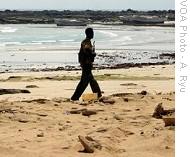 |
| A pirate taking a stroll on shore in Hobyo, Somalia, 22 Dec 2008 |
The sight of emerald-green waves breaking along Hobyo's shores is worthy5 of a postcard. The white sandy beach stretches endlessly onward6 and is broken up only by the outline of a quiet fishing village in the distance.
Walking into the village, several women cross our path, startled at the sight of a foreigner in Hobyo. They say nothing and move on quickly. We are later told that no foreigner has visited the village in more than a decade.
Despite its serene7 appearance, this tiny community, 260 kilometers south of the provincial8 capital Galkayo, has the dubious9 distinction of being one of the most dangerous places on earth. Along with the coastal towns of Eyl in northern Puntland and Haradhere to the south, Hobyo is a well-known sanctuary10 for pirates, who have operated along the Somali coast for the past several years.
The pirates made international headlines this year by seizing more than 40 vessels11 and earning an estimated $120 million in ransom12.
At least a half a dozen U.S. warships13 are currently in the area keeping an eye on the MV Faina, an arms-laden Ukrainian freighter hijacked14 by pirates three months ago. The ship is anchored about 30 kilometers off the coast of Hobyo. Another hijacked ship, a Saudi supertanker carrying an oil cargo15 worth $100 million, is anchored between Hobyo and Haradhere.
Pirates are demanding multi-million dollar ransoms16 for both vessels.
Anti-Pirate Sentiment Strong Along Somalia's Coastal Poor
Thirty-year-old Hobyo resident Sharif Wadad Ade speaks with bitterness about the pirates based here, describing them as outsiders who use the village only as a convenient hide-out.
Ade says if the pirates were from Hobyo, they would be spending their share of the ransom money to help the community. But he says the pirates come from different parts of Somalia, so they do nothing to help the people.
Local clan17 elder Saeed Aden adds that residents are also angry because they believe the threat of kidnappings posed by pirates is what is preventing western aid agencies from visiting the area and setting up offices.
Aden says Hobyo and other nearby coastal towns were nearly wiped out by the Asian tsunami18, which hit the Somali coast four years ago. Aden says many Somalis living along the coast are in desperate need of direct humanitarian19 assistance.
He says the villagers do not support the pirates and just want the international community to come here and help.
Little Evidence that Pirate Activities Benefit Coastal Communities
Such anti-pirate sentiment contradicts recent media reports that suggest residents in Hobyo and other coastal towns have a close relationship with pirates. Those reports say pirate activities have provided much-needed jobs and the pirates contribute to local economies by spending lavishly20.
But there is little in Hobyo to suggest that the residents are benefiting from the millions being paid to pirates. There are few goods on sale in the main market. The village has no running water or power. There is a pharmacy21, but no doctors. There is a school house, but there are no teachers or students.
 |
| A house in Hobyo, Somalia likely used by pirates with 4-wheel drive vehicles parked outside, 22 Dec 2008 |
The village appears to exemplify all that has gone wrong in Somalia since 1991, when the country's last functioning government fell and factions22 fought to fill the vacuum.
In June 2006, an Islamist movement took power from a group of U.S.-supported factional leaders, restored law and order and ended piracy in many parts of Somalia through the institution of strict Islamic laws.
The Islamists were ousted23 six months later by Ethiopian forces, who intervened to prop24 up a secular25, but unpopular, central government. Since then, Ethiopian and government troops have been fighting a losing battle to keep the Islamists, including a militant1 militia26 called the Shabab, from regaining27 power.
A pirate, who identifies himself only as Kahiye, says because Hobyo has been under the authority of local clans28, it has been easy for pirates belonging to the same clan groups to use Hobyo as a haven29.
But Kahiye says all pirates in central Somalia are under severe pressure from Islamists to disband.
He says in recent months, pirates trying to go ashore30 in any area controlled by the Islamists have been threatened and chased away.
Islamist Stance Against Piracy Wins Support
Somali sources tell VOA that the Islamists' tough stance against piracy has prompted many poor people in coastal communities to quietly begin supporting the return of Islamist rule.
And that is what they say may have emboldened31 local Shabab fighters to seize Hobyo on Sunday. According to eyewitnesses32, the Shabab launched a surprise attack against pirates in Hobyo and the two sides fought a ferocious33 battle in the village before the pirates retreated.
While the loss of Hobyo to the Shabab has dealt a clear blow to piracy, it raises another troubling question, especially for the United States and its western allies. They must now decide which, pirates or militant Islamists, pose a greater threat to global security and economy.
 收听单词发音


