voa标准英语2008-Sheikh Hasina's Awami League Heads to Victory in
搜索关注在线英语听力室公众号:tingroom,领取免费英语资料大礼包。
(单词翻译)
Bangladesh, one of the world's poorest countries, has moved a step closer to a return to democracy with a relatively1 peaceful parliamentary election. Officials say about 70 percent of the 81 million eligible2 voters went to the polls Monday. The Awami League, under former prime minister Sheikh Hasina, appears poised3 to form a new government based on Tuesday's early results for the 300-seat parliament. But it remains4 to be seen if the outcome will be accepted peacefully by the losers.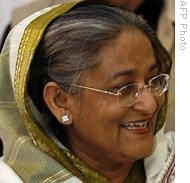 |
| Former Bangladeshi Prime Minister and Awami League party leader Sheikh Hasina Wajed after casting her vote at a polling booth in Dhaka, 29 December 2008 |
Defying a ban on political activity in effect until Thursday, chants and cheers erupted on the streets of Dhaka for Awami League leader Hasina's motorcade.
Initial Results Point to Landslide5
Party officials deemed the celebration premature6 but just hours later, as initial results were tabulated7 amid projections8 of a landslide, it became apparent Hasina will most likely be Bangladesh's next prime minister.
Immediately after casting her own ballot9, Sheikh Hasina told reporters she hoped to be serving the country again soon. But she said that no matter the results, Bangladeshis should accept the outcome.
The former prime minister spoke10 of irregularities with ballot papers at some polling stations and said there have been reported attempts of vote buying by rival parties.
Rival Zia Alleges11 Mismanagement at Polling Stations
Hasina's long-time bitter rival, Khaleda Zia, complained about alleged12 mismanagement of some polling stations.
Zia, who is also a former prime minister and a member of the Bangladesh Nationalist Party, says voting hours should have been extended because of the slow progression to the ballot boxes in many places.
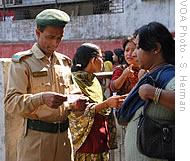 |
| Bangladesh security official checks voter registration13 at a polling location |
Several incidents of violence were reported and there were some election-related arrests around the country. But the polling, according to monitors, appeared relatively trouble-free compared to many previous elections here.
EU Observers Deem Balloting14 'Credible15'
The voting was monitored by 200,000 observers, including hundreds of accredited16 foreigners. The European Union team deemed the balloting "credible."
U.S. Ambassador James Moriarty visited polling stations in the capital.
"I noticed that a few people were not able to actually climb the stairs up to the voting booths," said Moriarty. "In some instances the police and the [paramilitary] Bangladesh Rifles were helping17 to carry them."
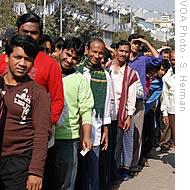 |
| Dhaka voters waiting in long lines to get into their polling station |
The interim18 government put hundreds of thousands of soldiers and law enforcement officers on the streets and banned motorized vehicles in major cities to minimize potential trouble.
A History of Autocratic Rule
Since gaining independence in 1971, Bangladesh, a county of about 150 million people, has spent more than half of that time under autocratic rule.
But economist19 and former Bangladeshi ambassador to Indonesia Salma Khan says that does not mean her country is incapable20 of sustained democratic governance.
"We have had two former governments who completed their tenure21 so I don't think that we have a bad record," Khan said. "But this time I feel that it also depends to a large extent on the people. Not only the politicians who are the major factor. It is a very different generation right now. And I do feel strongly that we will have a continued democracy."
Hasina and Zia contentiously22 traded power during a 15-year period. Both were jailed on graft23 charges by the army-backed interim government, which conducted a campaign during the past two years attempting to eradicate24 a legacy25 of widespread corruption26 in politics and business.
 收听单词发音


